
12 Dec La Palma Reconstruction – October 2025
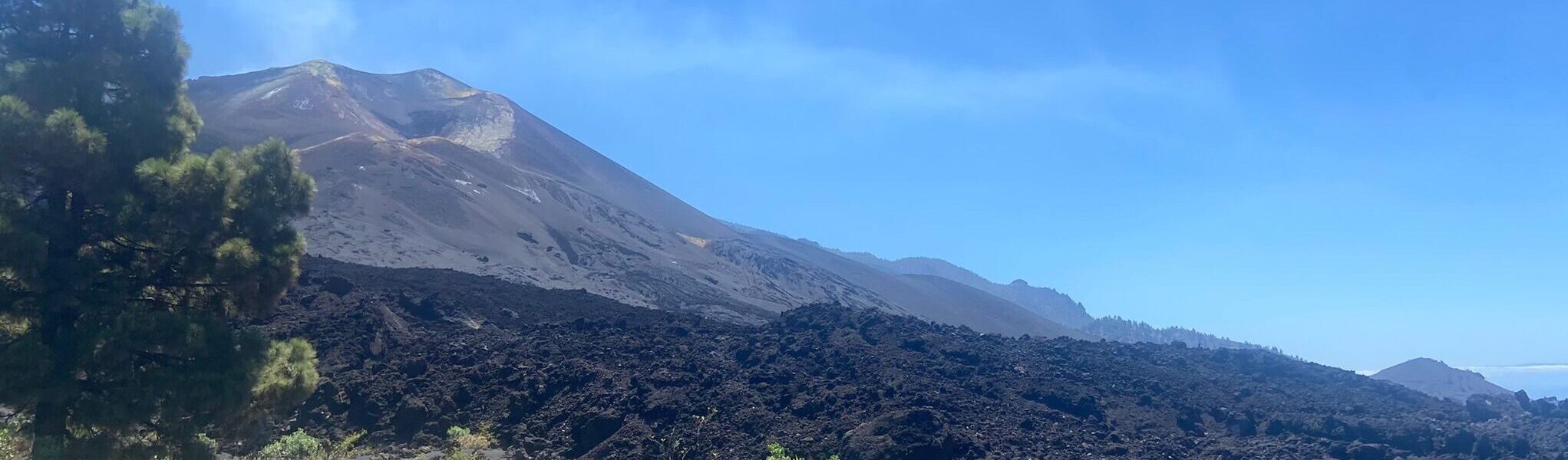
La Palma’s Reconstruction: October 2025 Update
News roundup from across La Palma regarding science occurring in La Palma, reconstruction efforts, aid provided to residents and industries, and other relevant news. Links to source articles are hyperlinked in taglines for each article.
Sources for all reconstruction updates: La Palma Ahora, Cabildo de La Palma, El Time, ABC España, El Valle de Aridane, El Dia, Mirame, Planeta Canario, Canarias 7, El Diario, National Geographic, El Pais, El Apurón, Diario La Palma
Reconstruction
- Latest reconstruction statistics – Addressing the Canary Islands Government, the Minister of the Presidency, Public Administrations, Justice, and Security of the Canary Islands Government, Nieves Lady Barreto provided updates on the reconstruction:
- There have been 7423 inquiries to the Office for People Affected by the Volcano since April 2024.
- The priority is reimbursing those for the losses of primary homes. This will be done via financing from the Canary Islands and Spanish Government (if they pay the annual €100 million demanded).
- The Canary Islands Government has compensated for 800 primary residences, covering 1,415 people.
- Files are ready for €90 million of more payments, paid either by the Spanish Government or alternatively surpluses from the Canary Islands Government
- €78.5 million is allocated for the housing plan for La Palma. 74 homes are under construction in El Paso and Los Llanos, with 11 homes in a renovated building in El Paso. The plot hosting the temporary wooden homes will be converted into 115 permanent homes. A tender for 120 additional homes in Los Llanos is being prepared, and the project should be ready in December, costing €28.7 million. In Tazacorte, ICAVI have been awarded the construction of 34 homes, and a tender is being prepared for 100 more.
- The Cabildo is currently reviewing what can be done with the ‘red’ zone of thickest lava flows.
- LP-211 road reopens – The LP-211 road, connecting Las Manchas to what was Todoque village and then Los Llanos de Aridane, has reopened after reconstruction, following its destruction 4 years ago during the eruption. The works for the 2.2 km road cost around €11 million.
- Action plan demanded for Las Manchas village – The PP Party of El Paso has demanded an action plan to improve the cleanliness, connectivity, and economy of Las Manchas, which was one of the areas most affected by the eruption.
- State ‘falsely closes’ reconstruction efforts – The CC party on La Palma have denounced that the state could ‘falsely close’ its contributions to the reconstruction on La Palma, despite reconstruction being nowhere near complete. This comment was made in relation to the ‘missing’ annual payments from the state for the reconstruction on La Palma.
Aid
- The Canary Islands Volcano Law has been published – The Canary Islands Volcano Law has been published, which recognizes the right to reconstruction and compensation from volcanic eruptions in the Canary Islands, and will be applied retroactively to the 2021 eruption to strengthen the recovery. The law can be read in full here.
- €100 million for agricultural reconstruction – ASEPALMA, representing the fruit industry on La Palma, says it trusts the Spanish Government will soon approve a decree law with €100 million for agricultural reconstruction in the Aridane Valley, for which an agreement was reached earlier in October. The Spanish Government confirmed the transfer of these funds was possible on the 31st July, but they are yet to arrive. They also denounce that producers have not yet received full agricultural incomes for 2023, 2024 nor 2025 in aid for unproductive land caused by the eruption. The timeline for approving the agricultural decree is sometime in mid-late November, and by the end of 2025 at the latest, with farmers being paid in February, according to Hector Izquierdo, Reconstruction Commissioner for La Palma.
- Calls for extension of 60% income tax reduction – The PP party in La Palma, in the latest joint commission for reconstruction, have demanded the Spanish Government transfer the ‘remaining’ €300 million ‘promised’, alongside a plan of when it will be paid. They also argue the 60% personal income tax reduction should be extended until 2027 to maximise the benefit for La Palma’s economy.
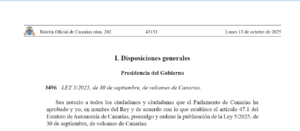
The header of the Canary Islands Volcano Law, published in October 2025, in the Official Gazette of the Canary Islands.
- Fuel bonus continues – Measures in La Palma, La Gomera and El Hierro to see a 20 cents per litre reduction in fuel prices on these islands has been re-approved until the end of 2025.
- Cuts in employment plan for La Palma – The PP Party in La Palma has denounced the latest Comprehensive Employment Plan for La Palma, where the economic allocation for 2025 reduces from €30 million to €12 million. They claim this will affect the economic recovery of the island following the eruption, and could lead to 100s of job losses.
- Possibility for state reconstruction funds via a new decree – The President of the Canary Islands, Fernando Clavijo, has explained how the lack of an annual general state budget in Spain (the current one has been extended for three years), has made it difficult to get more reconstruction funds from the state. However, he said there is promise in getting €60 million for the personal income tax reduction, and €100 million for reconstruction on the island, via a decree.
- State reconstruction funds for Tazacorte – Tazacorte City Council will receive €1.15 million in a new contribution towards reconstruction in the area from the Spanish Government, to allow them to comply with previous legislation from 2021 for necessary support measures following the volcanic eruption.
Science
- Subsurface pressure tests in Puerto Naos – In a project designed by CSIC and funded by IGN, tests were conducted to depressurise the subsurface in the ‘black zone’ in Puerto Naos where CO2 levels remain highest. This hopes to reduce pressure and accumulation of CO2 in the shallow subsurface, through drilling, extraction via vacuum pumps, and injection of clean air. In total, 1,002 homes have been authorised for return in Puerto Naos, with 49 for La Bombilla, along with 23 commercial premises. The latest update saw three garages and one more dwelling authorised for return.
- La Palma awarded for the ISVOLCAN project – La Palma has been awarded “Best Research Project” for the ISVOLCAN project monitoring health impacts of the eruption, by the Canary Islands Awards for Health Sciences and Biomedical Research.
- Cabildo de La Palma awarded for CO2 Alert project – The Cabildo de La Palma has been awarded the “Best Public Innovation Initiative” at the 2025 Disruptores Innovation awards, for its real-time monitoring of CO2 in Puerto Naos and La Bombilla, and the associated web and app-based resources.
- Tajogaite research conference – From the 10th-14th November in Los Llanos de Aridane, the Cabildo de La Palma is hosting the research and outreach conference ‘Tajogaite Eruption: Science and Society’, which will share the results and lessons learned after the eruption, and will have sessions open to the public.
- National Volcanological Centre updates – The joint bid by La Palma and Tenerife to host the headquarters for the future national volcanological centre of Spain has been the only proposal registered to the Government of Spain during the application period. However, the President of the Cabildo de La Palma has recognised that the bid needs to meet all of the necessary requirements before the bid is approved.
- Results from radon exposure tests in Puerto Naos – Results from monitoring radon gas, which can pose long-term health risks, in Puerto Naos has shown that all sensors aside from two in Puerto Naos and one in Tajuya show low levels below the reference limits. The monitoring was commissioned as CO2 can act as a carrier for radon, so areas with high CO2 concentrations may also have high radon concentrations.
- Continued marine recovery monitored – A study by the University of La Laguna and the Cabildo de La Palma has concluded that in 26 months, parts of the fish community in the waters close to the lava deltas had reached levels very close to a long-term reference taken from the nearby 1949 lava deltas. They also found continuous recovery of all species, rather than any major replacement of ‘lost’ species with different ones. It also documents how different types of marine creatures re-colonise at different speeds.
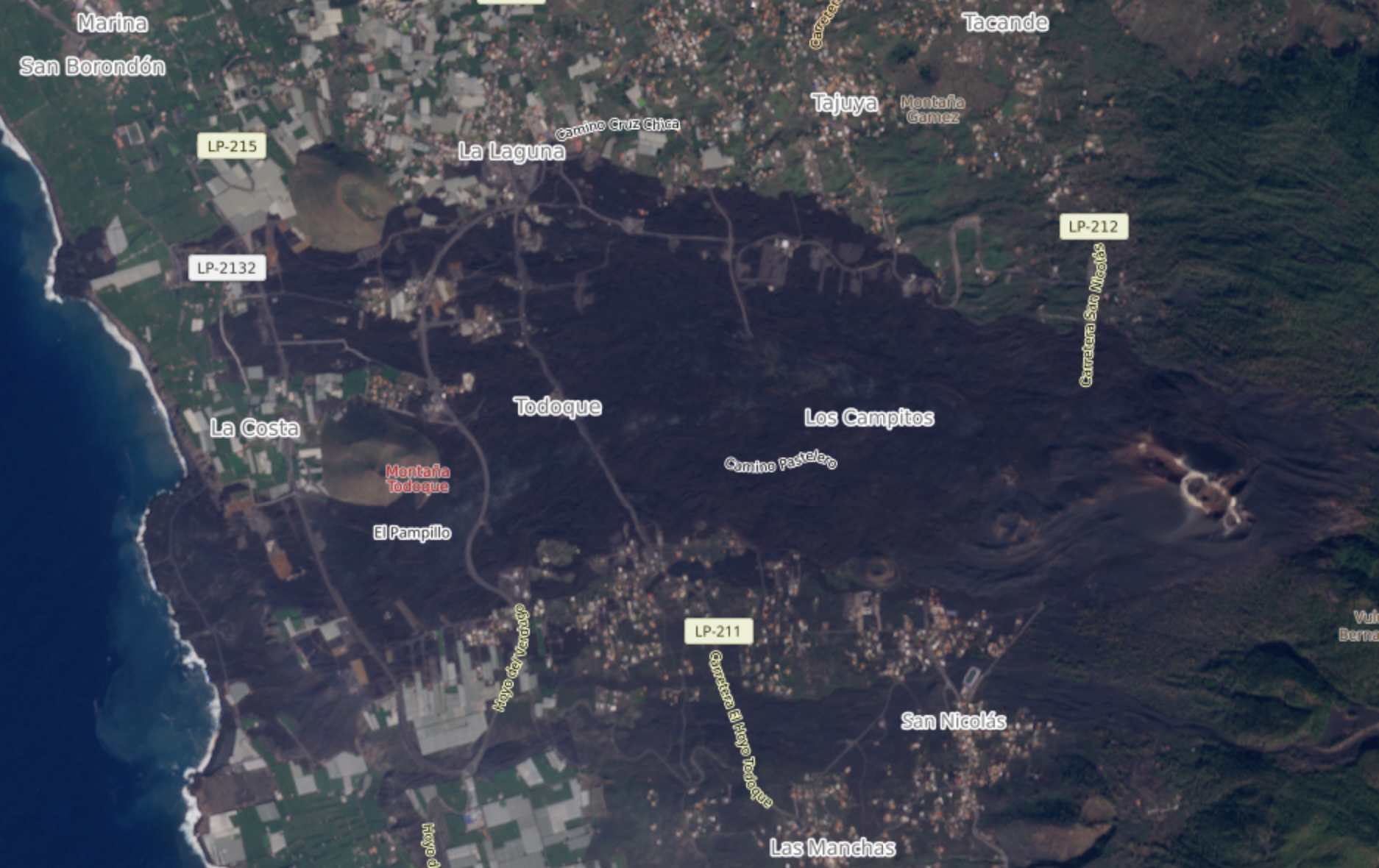
Satellite image from Sentinel-2 showing the latest reconstruction across the lava flows.
- Ombudsman and reconstruction commissioner meet – The Commissioner for Reconstruction Hector Izquierdo met with the Ombudsman for the Canary Islands, after complaints by affected citizens were submitted to the mediation body. The complaints relate to a range of issues, including aid management, property valuations, and compensation for farmers relying on irrigation.
- Joint reconstruction commission meets – The Joint Reconstruction Commission, with representatives from the Cabildo de La Palma, Canary Islands Government, and Spanish Government, has met for the first time since February 2024. The Mayor of Los Llanos argued these meetings should be held more often, and many financing-based agreements and collaboration agreements were made.
- New study on pre-eruptive earthquakes – A new study, authored by INVOLCAN, the University of Granada, ITER and others, presented a new approach to analyse the complexity and variability in seismic signals prior to the eruption. The results hint at different stages of seismicity based on certain characteristics extracted from this method, allowing for the identification of episodes not identifiable using traditional methods. In the future, these variations could be detected before an eruption and be used in forecasting.
- Citizens denounce lack of volcanic risk plan for La Palma – The Citizens Initiative for those Affected by the Volcano have criticised La Palma for not having published or approved an Island Action Plan for Volcanic Risk (PAIV). This document exists, finalised in 2019, but is not in the public domain, despite it being a legal obligation for the document to be available to the public so they can understand their island’s volcanic risk.
- Geothermal project updates – The Canary Islands Government has suspended the possibility of establishing a regulated tariff and operating framework for geothermal energy before the results of surveys are known, which has added uncertainty to the economic sustainability of the pilot projects. In total, the current pilots on Tenerife, Gran Canaria and La Palma have received €106 million in subsidies.
Other updates
- Tierra Bonita asks for reflection on emergency management – Tierra Bonita has called on authorities involved in the eruption to reflect on the lack of transparency in their management of the 2021 eruption, particularly not releasing the PEVOLCA recordings, claiming that this has lost them credibility and trust in the context signs of activity in Tenerife and managing a future volcanic emergency.
No Comments