
24 Apr The dark side of sustainable tourism: Cuna del Alma, Canary Islands
The dark side of sustainable tourism: Cuna del Alma, Canary Islands
Opinion article
By Sergio Alfaya, PhD Student in Earth Science and GeoTenerife researcher
“Cuna del Alma” is a planned luxury hotel in Puertito de Adeje, in southern Tenerife, selling itself as a sustainable resort. It has been at the centre of controversy since construction began. Mass protests against this project and the economic model it represents have been ongoing since April 2024, drawing international attention. This controversy seems to be reaching a tipping point, as a judge has reopened a criminal case for alleged criminal misconduct against the Mayor of Adeje (who publicly said there was nothing worth protecting in Puertito de Adeje and that this was the example of sustainable tourism he wants for the Canary Islands) and the developer, Filip Hoste. Construction has been halted in a small part of the project, but machinery is still at work a few metres away.
For many observers, this raises a broader, more uncomfortable question: what does “sustainable tourism” actually mean beyond a marketing label?
A new mass demonstration has been called for April 26th in Tenerife, with dozens of citizen platforms calling for a complete stop to the destruction in Puertito de Adeje while the 200-page independent report of alleged infractions that was presented is investigated and the court case is ongoing. They want the area to be protected, with an onsite History and Nature Museum to teach future generations about the island’s origins and its 2000-year habitation.
Locals aim to once again raise awareness against a predatory economic model in Tenerife, arguing that the heavy reliance on tourism in its current format isn’t sustainable with precarious work conditions, high environmental impact, unattainable housing and foreign investors (mainly foreign or non-Canarian) keeping most of the profit. This isn’t “tourismphobia”. It’s a concern about profit leeching, where wealth is generated by extracting value from one territory to benefit another.
A success story under strain
The Canary Islands are often presented as a model of tourism success. Since the 1960s, the archipelago has transformed from an economy largely based on the primary sector (agriculture and farming) into one of Europe’s leading holiday destinations. Around 18 million visitors arrive each year. The model has been so “successful” that the island of Tenerife receives more yearly international visitors (7.2 million) than countries like Brazil (6.6 million). This means that the tourism sector has turned into the backbone for labour, infrastructure, and public services, firmly placing the islands on the global tourism map.
Yet this success has brought intense pressure. Coastlines have been heavily altered, often irreversibly. Housing becomes increasingly more difficult each year for residents to afford. Water and energy systems are under strain, and concerns about environmental degradation are growing. Many workers in the tourism sector report low wages, job insecurity, and physically demanding conditions that can affect long-term health.
At the same time, a growing number of residents feel that the benefits of tourism are unevenly distributed. While the sector represents one of the main economic drives of the islands, there is a perception that its costs (social, environmental, and economic) are borne more widely than its rewards. The Canary Islands generated over €23 billion in tourism revenue in 2025, with the hotel sector accounting for a significant share of this income. Nonetheless, a lack of clarity in profit reporting means it is difficult to give a precise figure. With record profits and strong demand, foreign investors can pay as little as 4% tax under ZEC rules (Canarian Special Zone). It’s a model, say locals, that asset strips and funnels profits away from the Canary Islands, as most resorts and hotels are owned by foreign investors or hotel chains from mainland Spain who can repatriate their profits free of charge.
It is within this context that Cuna del Alma has become a focal point.
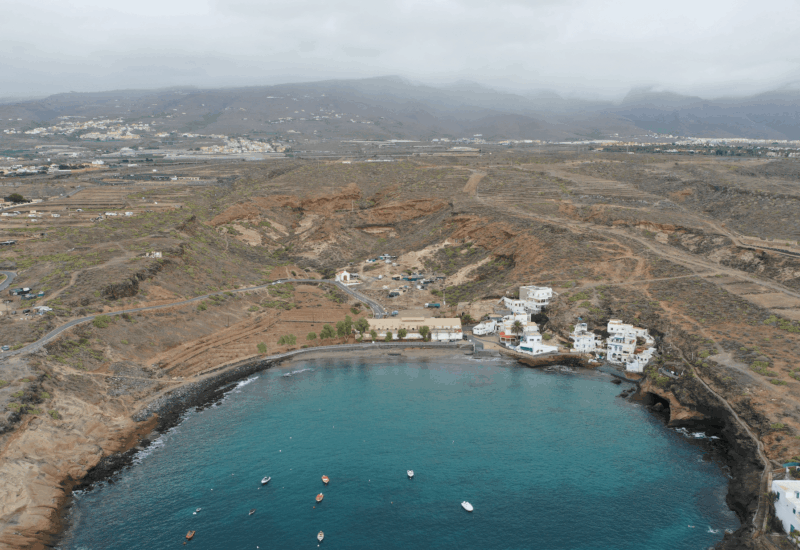
El Puertito prior to the construction of the Cuna del Alma project, source GeoTenerife.
A project that became a symbol
The Cuna del Alma resort dates back to the 1980s. At the time, it was approved with relatively little scrutiny, seen as another large-scale development on Tenerife’s already overdeveloped southern coast.
However, by the time construction began in 2022, public attitudes had shifted. What might once have been considered routine development was now viewed by many as part of a model increasingly seen as unsustainable.
Early construction works quickly intensified concerns. Archaeological remains linked to the indigenous Guanche population (the only indigenous people known to have lived on the islands before the arrival of the Spanish Conquista, now “officially” considered extinct) were uncovered on site. Environmental groups raised alarms about the destruction of coastal habitats and the impact on protected plant species. Activists failed to find a proper environmental impact report for the project, mandatory documentation for this kind of development, and especially relevant as the site adjoins two protected areas: La Caleta and the Teno-Rasca marine strip.
In response, activists mobilized. They occupied the site, organized protests, and brought wider attention to a project that had previously received little public scrutiny. In response, authorities issued precautionary suspensions, and a series of investigations, sanctions, and technical reports followed. Yet these measures did not resolve the conflict. Instead, they helped elevate it.
By 2023, Cuna del Alma had become part of a broader debate across the Canary Islands, and served as the focal point to the new, beaconing question of whether the tourism model it represents remains viable.
From local protest to regional movement
In 2024, tens of thousands of people took to the streets across the Canary Islands and in several European cities under a shared message: “Canarias tiene un límite” (the Canary Islands have a limit). Cuna del Alma became a central symbol in this movement. For many, it represented the contradictions of a development model that continues to expand while claiming to be sustainable.
At the same time, the environmental significance of Puertito de Adeje became more widely recognised. A protected plant species (Viborina triste) was identified on site, leading to a year-long halt in construction. The subsequent decision to allow their relocation by the Town Hall was controversial. Furthermore, a detailed geological investigation carried out by GeoTenerife with local and international experts led to the area being designated a Site of Geological Interest (LIG) by Spain’s Geological Survey (IGME-CSIC), with a high level of protection priority. LIG IC4049 quickly became the most adopted site in the country under IGME’s “Adopt a Rock” programme, beating other leading sites nationwide tenfold, further cementing its value.
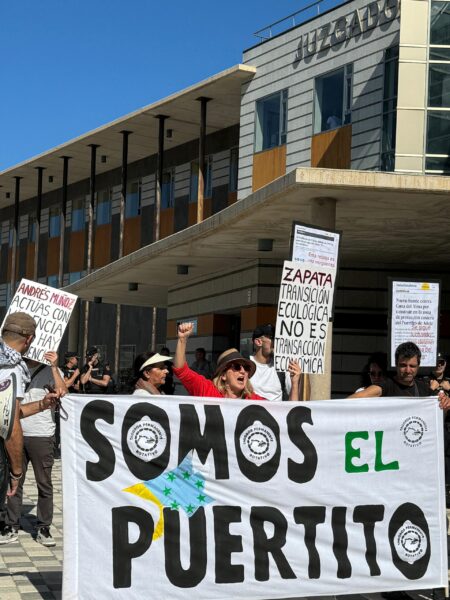
Protestors outside the court house demonstraring against the Cuna del Alma development. Source GeoTenerife.
Public discontent continued to grow, amplified by social media, in the absence of detailed local media coverage. Protest took creative forms, including music and Carnival performances. Yet despite sustained mobilisation, construction largely continued, and official responses were perceived as limited or delayed.
A legal turning point
In 2025, the conflict entered a new phase. A group of citizens filed a criminal complaint against the mayor of Adeje and the project’s developer. Acting independently and fundraising to cover their legal costs, they challenged the project through the courts. Led by Tagoror Permanente, the group whose spokesman is a geography professor at the local public university (ULL), Victor Martín, includes affected resident Juan Galindo whose frontline property has been expropriated under dubious circumstances; Guacimara Fuentes, a local content creator who publishes groundbreaking interviews with people speaking out against perceived corruption in southern Tenerife; Eloy Cuadra, longtime campaigner and author; and Rebelión Científica. They came together to form a new Association, Puertito Libre, to present their case to the courts.
The case was initially dismissed, but the complainants appealed to the Public Prosecutor, arguing that there were clear indications of possible criminal behaviour. The Prosecutor agreed and asked the judge to reopen the case. She did, and has ordered a halt to construction in approximately 5% of the site, consisting of the area closest to the coastline.
For many, this represents a significant shift. Previous cases were heard and tried by the authorities themselves, but it is now under judicial scrutiny. But the limited scope of the stoppage has also raised concern. While construction has been halted in a limited area, large-scale destruction continues elsewhere on the site. This has intensified debate: on what legal and ethical basis can construction proceed while potential irregularities have been acknowledged in part of the project in a criminal court case? The destruction is continuing apace, the question is pressing.
Competing visions of development
The outcome of Cuna del Alma is being closely watched, particularly as other large-scale tourism developments are planned across the Canary Islands. Supporters of such projects argue that they bring investment, employment, and economic growth. In a region heavily dependent on tourism, these are significant considerations.
However, a growing segment of society questions whether this type of development is compatible with the islands’ environmental limits and social realities. The concern is not tourism itself, but the form it takes and who ultimately benefits.
This tension is clearly visible in Puertito de Adeje. Construction has stopped and restarted. Legal processes are ongoing. Public attention remains high. The site itself has become a physical expression of an unresolved question.
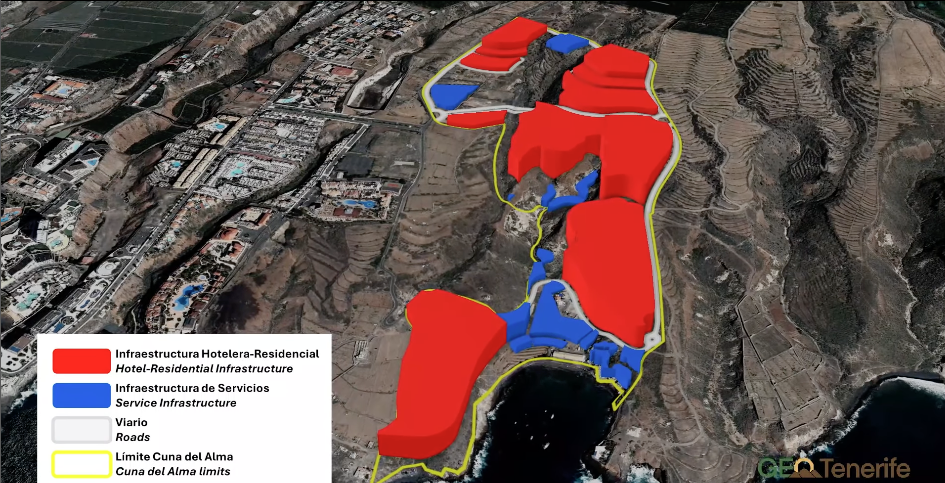
Limits of the planned Cuna del Alma construction (Sergio Alfaya, 2024). Click to expand this image.
No Comments