In collaboration with
- The Director Producer of The LAVA BOMBS project, Sharon Backhouse
- Jaime Coello, Hydrogeologist and Director, Fundación Telesforo Bravo.
- Local camera team and heritage expert
- Local scholars: Sergio Alfaya, GeoIntern 2023 and José Miguel GeoIntern 2025
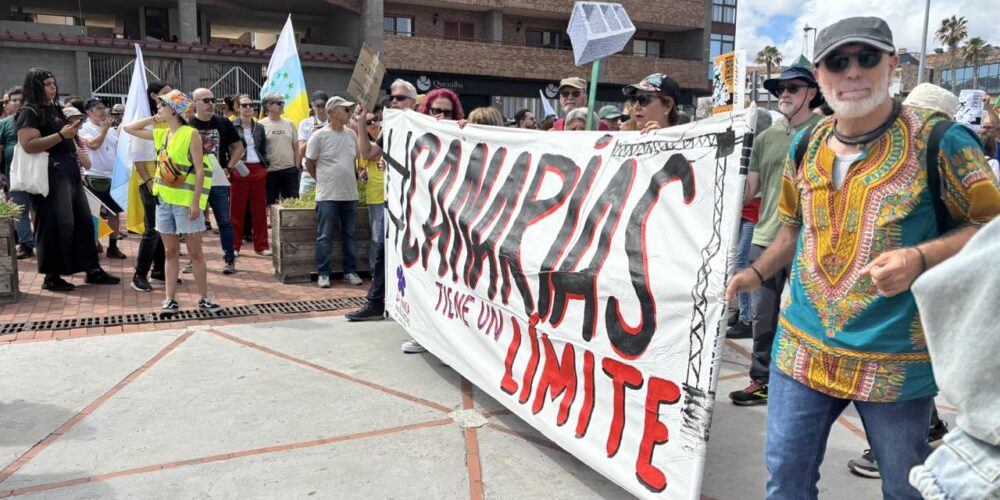
For decades, the tourism model in the Canary Islands has relied on attracting an ever-increasing number of tourists. This is unsustainable in a fragile biodiversity hotspot where glorious natural resources and endemic wildlife are under increasing strain. Local activists are becoming vociferous in their rejection of luxury developments destroying some of the last vestiges of the natural environment on the coast of the Canary Islands and have come up against fierce opposition from developers. We believe it is time to rethink the old development model. Thanks to two years of research on previous GeoIntern programmes, the geological deposits in Puetito de Adeje were added to the Spanish National Survey’s inventory of sites of geological interest with a high protection priority.
We are working closely with local environmental and resident groups to call for their protection from a proposed luxury tourism resort. Our advocacy work has included a range of interviews with local, national, and international TV and press outlets. As part of this programme, you will work alongside a local film crew to produce a high-quality interview using the science communication skills you gained through week 1 and 2.
We are currently producing a documentary on the challenges of implementing a more sustainable tourism model in the Canary Islands, called “Plunder for Profit”, which you will have the opportunity to contribute to and be credited for. This programme is not just an academic exercise but is at the heart of GeoTenerife’s advocacy for policy change in the Canary Islands, using our work to amplify local resident concerns. We are looking for applications from students who are environmentally conscious and keen to make an impact, preferably with some communication/outreach experience.
These past few days we’ve been taking quadrats (think like a frame you lay on the ground to visualize a section) to survey vegetation and learn about native, non-native and invasive species. We are navigating some rocky terrain but what a beautiful barranco! pic.twitter.com/aJzOEjpLJj
— Elisabetta S (@ElisabettaSav) July 18, 2024
Previous GeoIntern Programme D research
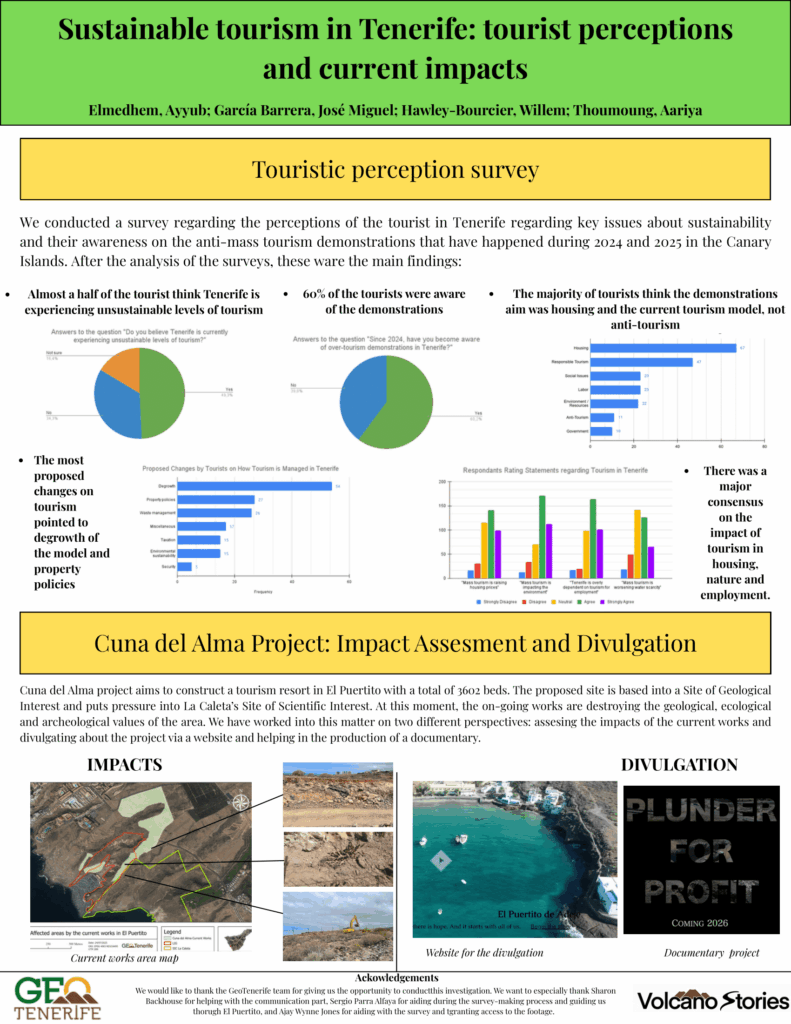
Tourist perception on anti-mass tourism demonstrations and sustainable tourism in Tenerife, Canary islands.
Ayyub Elmedhem¹, José García Barrera², Willem Hawley-Bourcier³, and Aariya Thoumoung⁴
1 University of Liverpool
2 University of La Laguna
3 Luther College
4 Krea University
Abstract
The study of sustainable tourism explores how destinations can balance economic benefits with environmental protection and social well-being. In regions like the Canary Islands, where mass tourism has shaped both landscapes and livelihoods, understanding public perception and on-the-ground impacts is essential for redefining development models and achieving long-term sustainability.
Tenerife, one of the most visited islands, faces increasing tension between rapid tourism expansion and environmental conservation. Ongoing construction of large resorts such as the Cuna del Alma tourism project has already sparked public outrage and large-scale demonstrations throughout 2024–2025.
This study investigate tourist perceptions of tourism, using a structured bilingual (English–Spanish) questionnaire to assess awareness of sustainability issues, recent demonstrations, and perceived impacts of mass tourism on housing, environment, and employment. In-person surveys were conducted with 402 tourists across hotspots including Los Cristianos, Las Américas, El Médano, Puerto de la Cruz, La Orotava, and La Caleta.
Nearly half of the surveyed tourists viewed current tourism as unsustainable, and 60% were aware of the 2024–2025 demonstrations. Most understood the protests as calls for housing reform and tourism model change rather than anti-tourism sentiment. Respondents recognised strong impacts on housing, ecosystems, and employment, with solutions focusing on degrowth policies and property restrictions.
Findings reveal growing tourist awareness of sustainability challenges and support for responsible tourism. Complementary outreach, including a dedicated awareness website and participation in a documentary, communicated findings and amplified local voices. This integrated research–communication approach illustrates how student-led investigations can contribute to public understanding, policy dialogue, and a more sustainable future for the Canary Islands.
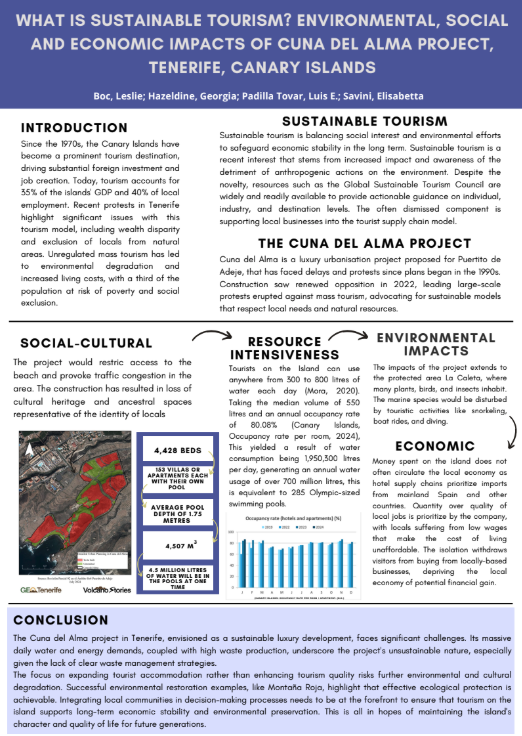
What is Sustainable Tourism? Environmental, Social and Economic Impacts of Cuna del Alma project, Tenerife, Canary Islands (2024)
Boc, Leslie¹; Hazeldine, Georgia²; Padilla Tovar³, Luis E.; Savini, Elisabetta⁴
¹ Tufts University, ² University of Birmingham, ³ Instituto Tecnológico y de Estudios Superiores de Occidente, ⁴ University of West Florida
Abstract
While tourism has been the foundation of the economy in the Canary Island archipelago for decades, locals have been affected by the industry model that promotes overconsumption and exploitation of resources. The following literature review and analysis focuses on the island of Tenerife, the most visited of the Canary Islands. Specifically, it focuses on the mega hotel project, Cuna del Alma, set to be constructed next to a natural protected area. By assessing the environmental, social, and economic impacts that this project would have on the local population of Tenerife, this study aims to expose the problems of the current unsustainable tourist model of the island. Furthermore, it defines what sustainable tourism stands for, and proposes environmental restoration as an alternative plan for degraded territories historically destined for the solely purpose of urbanization and comercial use.