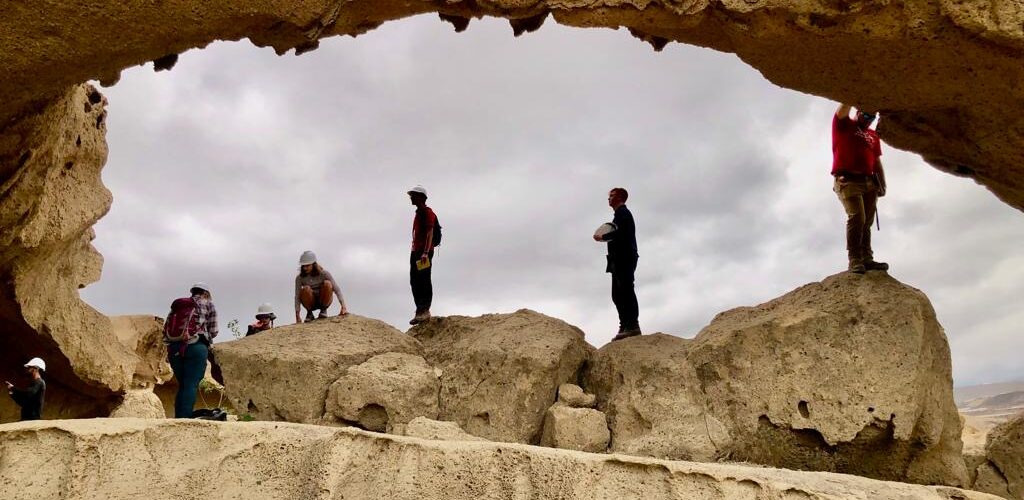
An intensive fortnight with Dr Richard Brown of Durham University to undertake original research to further our knowledge of Tenerife’s prehistoric explosive volcanic eruption events.
Dr Brown is a world expert on explosive volcanology and Tenerife ignimbrites. He is a volcanologist working in Higher Education in the UK with >20 years of experience conducting field-based research on volcanoes around the world. He teaches university courses in Volcanology, Geographic Information Systems (GIS) in Earth Science, Optical Mineralogy, and Igneous Petrology. He has conducted fieldwork in Tenerife, Italy, UK, Iceland, USA, El Salvador, Ascension Islands, Botswana, Tanzania, South Africa, Germany, Namibia, Turkey and India and published >60 scientific papers and book chapters.
Teaching for both weeks will be fully supported by our resident volcanologist, Alexis Schwartz and Master’s student (and GeoIntern graduate 2023) Ethan Hamilton.
Constraining the frequency and size of explosive Plinian eruptions on Tenerife
Tenerife has a long history of explosive Plinian eruptions that have repeatedly showered pumice and ash across the island and sent destructive pyroclastic flows out from the caldera. This programme is intensive fortnight piecing together the eruption history of Las Canadas Caldera. It will involve exploration and reconnaissance by foot and by car, stratigraphic correlations and reconstructions, and detailed, methodical fieldwork characterising pumice fall deposits, ash fall deposits, ignimbrites and sediments at various locations around the island. This type of research forms the foundations of volcanic hazard assessments and contributes important data to eruption forecasts and planning scenarios.
In the last 5 years, Geointerns have contributed to fieldwork that has doubled the number of known Plinian eruptions on the island over the last 1 Ma and fundamentally changed our understanding of the island’s past eruptive behaviour. We know there is more to find.
Field work
-
Training in both macro and micro ‘fingerprinting’ techniques of volcanic deposits, i.e., the observation skills required to describe and characterise deposits
-
Field discussions to help form your ability to interpret the style, phase, and intensity of an eruption
-
Development of stratigraphic logging skills and rock sampling for later geochemical analysis
-
During the programme, your group will very likely discover new deposits never described in the academic literature, you will be contributing to original and ongoing research. See here for Ryan Bailey’s (GeoIntern 2021) master’s thesis. See here for Ethan Hamilton’s (GeoIntern 2023) poster at VMSG.
Please note that this programme can at times be physically intensive, with long field days hiking in Tenerife; we do our best to mitigate any risks and moderate the intensity. This programme would be ideal for students looking to study physical volcanology through fieldwork.
Gracias a todos los participantes en @geointern 2025 por su trabajo y aporte a la ciencia.
— VPC GEOTENERIFE SL / TenerifeNature (@TenerifeNature) September 15, 2025
Gracias especiales a R. Brown @Earth_Sci_Richy por otro año inolvidable con la colaboración de @Ethan_H662 y A. Schwartz
Foto: trabajos geológicos en depósitos plinianos (TF)@GeoTenerife pic.twitter.com/KlJzkFcFhj
Thread Continued:
— Peter.t.Lunt (@PeterTLunt) July 16, 2024
From 'jam-sandwich' Plinian pumice falls to blinding white ignimbrites, the Diego Hernandez Formation has a dramatic range of deposits.
Over the past 2 days, we've been carefully studying them, focusing particularly on the La Cruz sequence.#volcanoes pic.twitter.com/M4Oia8rlxV
Previous GeoIntern Programme A research
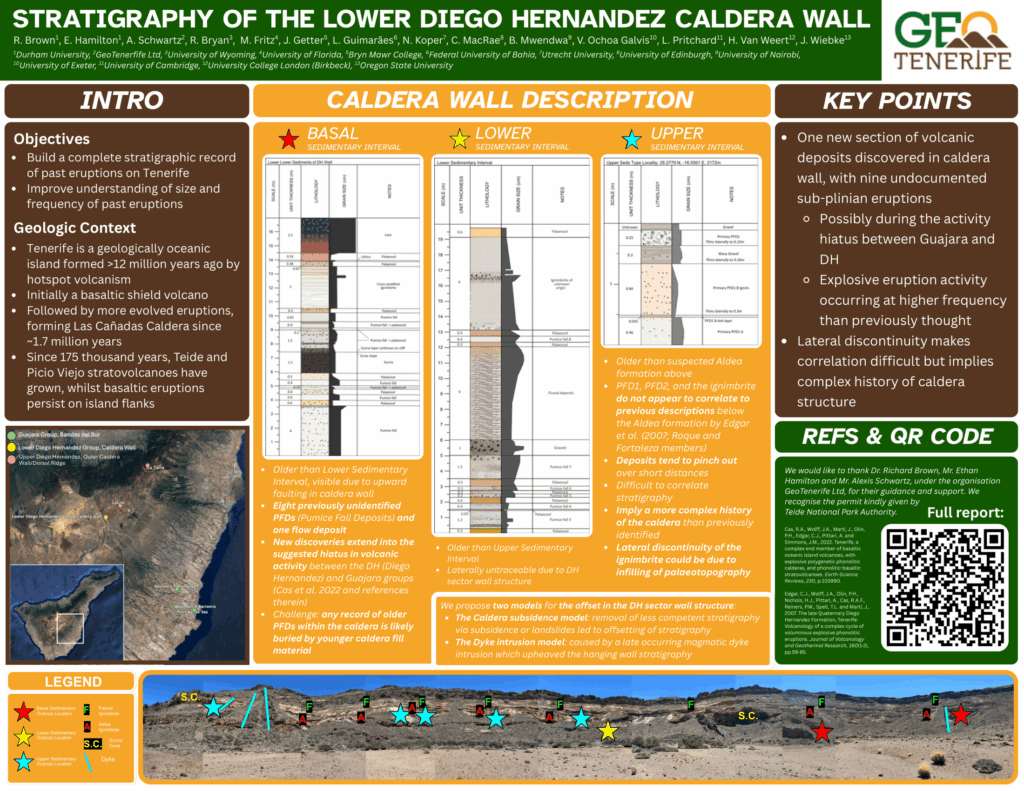
Reconnaissance of Ignimbrites and Fall Deposits of the Guajara Group of the Bandas del Sur region, and the Diego Hernández Group, Las Cañadas Caldera, Tenerife. (2025)
Rachel Bryan¹, Mackenzie Fritz², Jay Getter³, Careen MacRae⁴, Brilliant Mwendwa⁵, Nick Koper⁶, Valeria Ochoa Galvis⁷, Lucy Pritchard⁸, Hannah Van Weer⁹, and Julia Wiebke¹⁰.
1 University of Wyoming, 2 University of Florida, 3 Bryn Mawr Geology, 4 University of Edinburgh, 5 University of Nairobi, 6 Utrecht University, 7 University of Exeter, 8 University of Cambridge, 9 Birkbeck University of London, and 10 Oregon State University.
Abstract
Understanding the eruptive histories of volcanically active regions is essential for anticipating future hazards and assessing risk. Tenerife, a volcanic island off the northwestern coast of Africa in the Canary Islands, has a complex geologic history. It hosts magma compositions ranging from basaltic to phonolitic, producing diverse eruptive styles including explosive Plinian eruptions associated with pyroclastic density currents. While some explosive events are well-documented in the stratigraphic record, significant gaps remain, in part due to preservation bias favoring ignimbrite forming eruptions. Unexplored stratigraphy and pumice fall deposits across Tenerife may hold key information about the island’s full eruptive history. Through reconnaissance surveys and detailed stratigraphic logging of previously undocumented pumice fall deposits, we aim to refine the eruptive framework of Tenerife, particularly within the
lower Diego Hernández (DH) Group exposed along the Las Cañadas Caldera wall. Three key sedimentary intervals (basal, lower, and upper) were logged in detail. In the basal interval, we identified eight new pumice fall deposits and one flow unit, suggesting a potential shorter hiatus between the DH and Guajara Groups. In the upper interval, two pumice fall deposits were described and laterally traced, although their tendency to pinch out suggests a more complex depositional and structural history than previously recognized. These complexities are further recorded in caldera wall exposures, which include laterally continuous to steeply tilted fault blocks composed of ignimbrite, fallout, scoria, and lava flows. We propose two possible models to explain structural offsets in the DH sector: (1) caldera subsidence or (2) dyke intrusion. This work provides new insight into the frequency and distribution of explosive eruptions since the formation of the Las Cañadas Caldera (~1.7 Ma), improving hazard assessments for future eruptive activity.
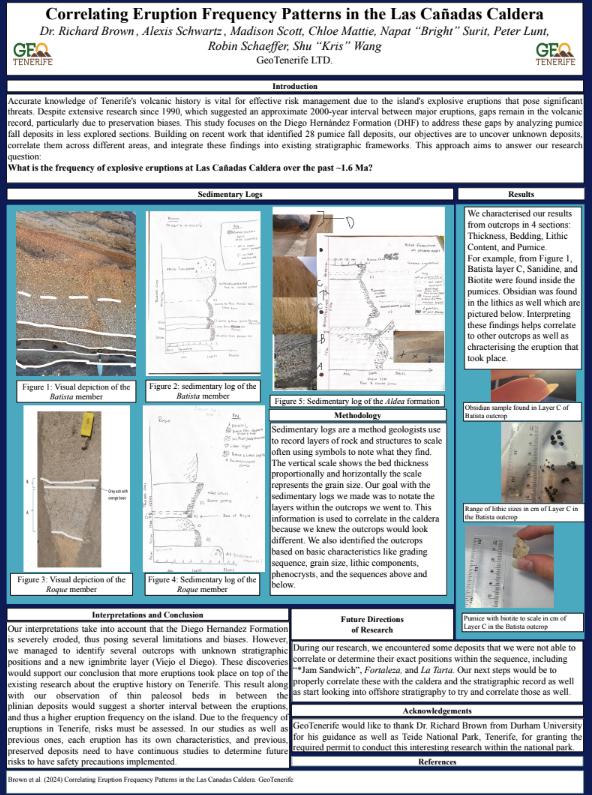
Correlating Eruption Frequency Patterns from the Las Cañadas Caldera (2024)
Scott, Madison³; Mattie, Chloe⁴; Surit, Napat (Bright)⁵; Lunt, Peter⁶; Schaeffer, Robin⁷; Wang, Shu (Kris)⁸. Brown, Dr. Richard¹; Schwartz, Alexis²
¹ DURHAM UNIVERSITY, DURHAM, ² GEOTENERIFE LTD, ³ WESTMINSTER COLLEGE, MISSOURI, ⁴WEST CHESTER UNIVERSITY, PENNSYLVANIA, ⁵WHITMAN COLLEGE, WASHINGTON, ⁶ DURHAM UNIVERSITY, DURHAM
⁷ ROBIN SCHAEFFER, CORNELL COLLEGE, IOWA, ⁸ UNIVERSITY OF CALIFORNIA SAN DIEGO, CALIFORNIA
Abstract
Understanding Tenerife’s chronological eruptive history is essential for managing risks and preparing for potential disasters. This study focuses on the frequency of explosive eruptions at Las Cañadas Caldera over the past ~1.6 million years, with an emphasis on the Diego Hernández Formation (DHF). Detailed sedimentary logs were developed to record deposit composition, texture, and structure, facilitating a thorough analysis by comparing these observations with
previous research. During the fieldwork process, several outcrops with unknown stratigraphic positions (“*Jam Sandwich”, La Tarta) as well as a previously unidentified ignimbrite deposit have been found. These discoveries would support our conclusion that more eruptions have occurred on top of the current knowledge about eruption history on Tenerife. Along with the observation of thin paleosol beds between the eruption deposits, this potentially implies a higher eruption frequency on the island, which will be helpful in terms of volcanic hazard preparation and risk management.