
05 Feb La Palma Reconstruction – January 2026
La Palma’s Reconstruction: January 2026 Update
News roundup from across La Palma regarding science occurring in La Palma, reconstruction efforts, aid provided to residents and industries, and other relevant news. Links to source articles are hyperlinked in taglines for each article.
Sources for all reconstruction updates: La Palma Ahora, Cabildo de La Palma, El Time, ABC España, El Valle de Aridane, El Dia, Mirame, Planeta Canario, Canarias 7, El Diario, National Geographic, El Pais, El Apurón, Diario La Palma
GeoTenerife updates
- GeoTenerife Presents at VMSG 2026 – GeoTenerife’s Project Manager Ajay Wynne Jones presented at the Volcano and Magmatic Studies Group (VMSG) annual conference at the National Oceanographic Centre/ This is the largest annual meeting of volcanologists in the UK, and Ajay presented: “Communicating Volcanic Risk in the Canary Islands: Building Trust, Clarity, and Preparedness”, based on ongoing work for GeoTenerife’s VolcanoStories and Volcanic Readiness projects, and lessons learnt from La Palma.
Reconstruction
- LP-2 recovery begins – The recovery of the LP-2 has begun between Tajuya and Las Manchas, expected to cost €24.1 million over 14 months for the 2.3 km route. A perspective piece has been published detailing the complications of this reconstruction project up until this point.
- Transparency – Tierra Bonita has denounced the lack of transparency in the modification of the LP-2 project, claiming there is not a complete public file available on the contracting authority’s website, which is against the law.
- Expropriation – 95 plots of land covering 95,000 m2 have been listed for expropriation to make way for the new route.
- Canarian Government oversee project – Representatives of the Canary Island Government visited La Palma to see the beginning of the project.
- Challenges – The technical team have explained that where the surface temperatures have still been identified as very high, progress will be slow as they will slowly remove material and water the subsoil.
- New recycling centre proposed – The Government of the Canary Islands has proposed a new permanent recycling Centre in Los Llanos de Aridane, to replace the one destroyed by lava flows in the 2021 eruption. A budget of €350,000 has been set for its construction.
- La Laguna School reconstruction – The Minister of Education of the Canary Islands Government, Poli Suárez, has defended the administrative management and the time required to promote the reconstruction of the CEIP La Laguna. The contract for its reconstruction has still yet to be awarded, which is worth around €5 million over 18 months.
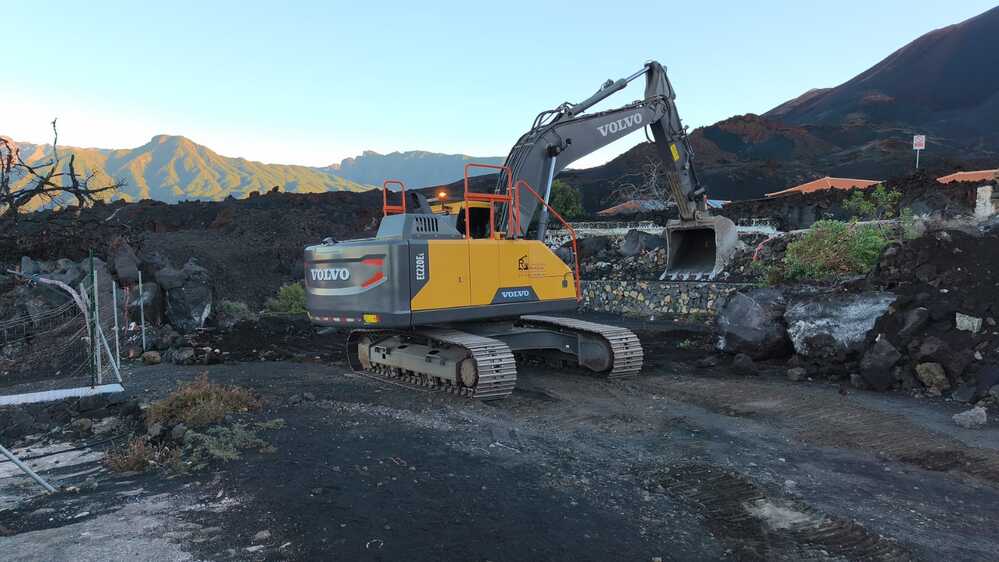
The bulldozers enter LP-2 and begin the recovery of one of the main roads affected by the volcano. El Time (2025)
- Canary Islands decree – The president of the Canary Islands has been preparing the next Canary Islands decree for the next four years, which will be sent to Madrid for negotiation with the state. Among the requested items are €100 million annually from 2026, 2027 and 2028 for reconstruction.
- La Laguna football field reconstruction – The reconstruction of the football field in La Laguna is being organised, however there are currently complications over the regularisation of the land, with multiple owners, imprecise boundaries and outdated deeds involved.
- Participatory process for roundabout design – The Cabildo de La Palma has opened a participatory process for citizens to contribute ideas for the design of roundabouts along the LP-213 road across the lava flows. Other roundabouts already have sculptures on them dedicated to the reconstruction and the losses of the eruption.
- 152 agricultural licenses in Tazacorte – 152 licenses for agricultural reconstruction in Tazacorte have been granted overall, with 150 more currently being processed.
- New waste transfer plant – A new waste transfer plant is being constructed in Callejón de la Gata, the industrial estate destroyed by the lava flows, that is currently being reconstructed.
- Demand for fairness in reconstruction – A perspective from Tierra Bonita has demanded that there are no first and second class victims of the eruption, and has pointed out aid that has yet to be delivered or current areas of uncertainty for those affected.
Aid
- Aid for second homes starting to be delivered – The Canary Islands Government has begun notifying affected people who lost their second homes of their grants. €50 million is currently allocated for these grants, and 83 second home owners have been notified.
- Debates between agricultural organisations over aid – There have been debate over the process of paying agricultural aid, for which an agreement was reached between Asepalma Association and the Government of the Canary Islands in late 2025. Four other agricultural associations have since questioned this process in a letter to the Canarian Government, which the Canary Islands Association of Agricultural Workers has rejected.
- €400,000 for housing – Los Llanos de Aridane have allocated €400,000 towards housing construction, granted to those affected by the eruption to cover costs of drafting plans for new homes. Applications open on the 22nd January for 20 days.
- Emotional recovery support project ends – The PEX La Palma Psychosocial program, which supported emotional recovery after the volcano, has ended. The project began in 2024 with a budget of €800,000, and hired 21 people on the island.
- Demands for aid from the ‘Volcano Law’ – Carlos Cabrera, councilor for the Popular Group in the Cabildo of La Palma, points out the need to effectively activate the aid contemplated in the Canary Islands Volcano Law for the recovery of agricultural and livestock farms affected by the eruption. It guarantees aid to cover costs needed to recovery crops and livestock farms.
- Ongoing affected business aid – 91 businesses affected by the volcano are receiving support to cover day-to-day expenses and stay open, with aid of up to €2,950 per business, from applications made in September 2025.
- Fuel subsidy continues – The fuel subsidy of €0.20 per litre, on La Palma, in part due to increased transportation costs following the eruption, will remain in force until March 2026.
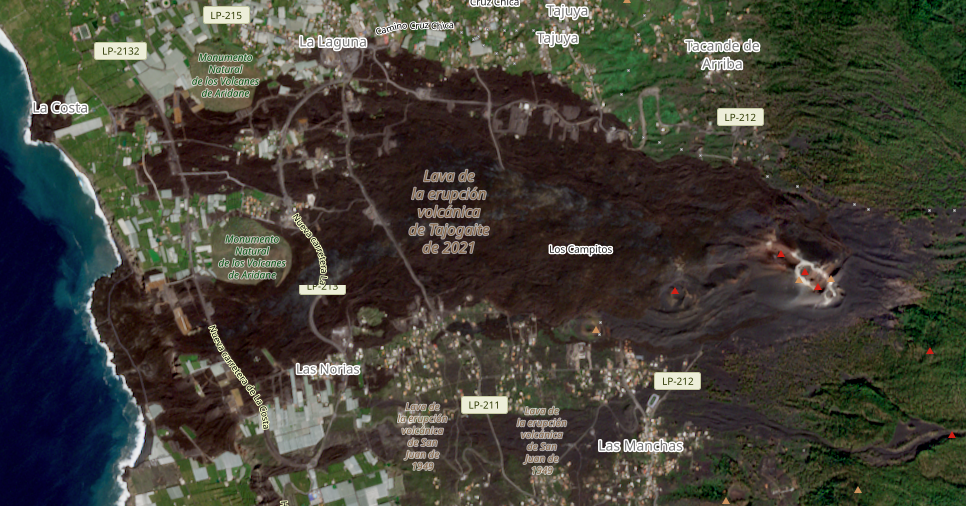
Latest Sentinel-2 satellite image from 1st February 2026 showing the latest reconstruction progress on La Palma
Science
- Faults identified during eruption continue to move – Faults close to the site of the 2021 eruption on La Palma have continued to slowly move, or creep, at up to 3 mm/yr since the eruption, according to a new study by IGME-CSIC, using a precise ‘crack gauges’ to measure displacement in fractures. Whilst some of these faults were identified during the 2021 eruption, movement on some of them has been affected homes since the 1980s.
- University of Milano-Bicocca and INVOLCAN hold field day – Students and Professors from the University of Milan-Bicocca joined a field day with INVOLCAN in the La Caldera de Taburiente National Park, to collect water and gas samples from the CO2-rich springs in the area.
- New method in forecasting eruptions pioneered in La Palma – A new methodology based on seismic signals before an eruption has been selected by the UN Office for Disaster Risk Reduction as a tool to be implemented worldwide. The tool, developed by IGN, IGME and the University of Valencia, aims to identify when rising magma reaches a ‘point of no return’ and will reach the surface, based on changing patterns of seismicity.
- Students take part in water quality measurements – High school students from Madrid, Valencia and La Palma are participating in a study of water quality in reservoirs in La Palma following the eruption, using buoys designed and manufactured by the students, measuring conductivity, pH, and temperature of the water.
- Puerto Naos returns – More than 1,100 families have returned to Puerto Naos following the Cabildo’s gas monitoring and management efforts, with plans for more to return in early 2026.
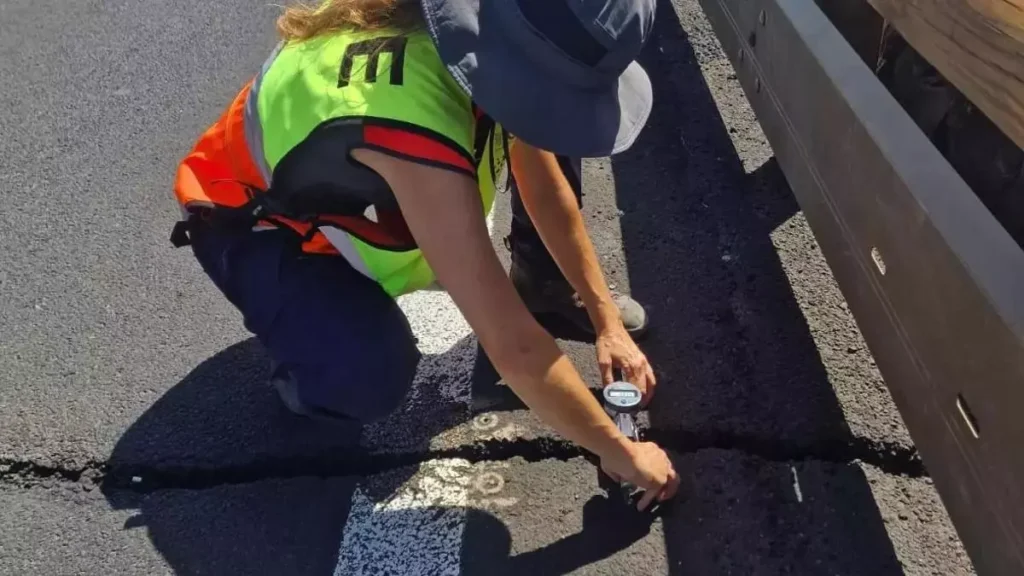
The faults identified in the Tajogaite eruption continue to shift through slow movements. El Diario (2026)
No Comments