Introducción
El archipiélago canario ha experimentado una intensa actividad volcánica a lo largo de millones de años, y algunas de sus islas continúan presentando actividad en la actualidad; por lo tanto, es probable que se produzca una nueva erupción en el futuro. No obstante, resulta prácticamente imposible predecir con exactitud cuándo ocurrirá, dónde tendrá lugar o cuál será su magnitud.
Los científicos realizan un seguimiento continuo de los sistemas volcánicos con el fin de caracterizar su actividad de fondo o “actividad basal”, lo que permite identificar posibles anomalías en el comportamiento volcánico que puedan indicar la inminencia de un proceso eruptivo. En esta página se describe qué instituciones se encargan de la vigilancia de la actividad volcánica y de la gestión de la respuesta ante emergencias, junto con una cronología de los principales episodios de inestabilidad registrados en los últimos veinte años.
Es importante referirse a fuentes oficiales de información en una emergencia. Los principales sitios para encontrar información oficial sobre los eventos volcánicos son:
Cuentas de twitter de los Cabildos Insulares
Cabildo de Lanzarote
Cabildo de El Hierro
Cabildo de La Palma
Cabildo de Tenerife
Otros grupos que también comunican sobre riesgos volcánicos
Estado actual de cada isla
VTL - Current volcanic traffic level by Ajay Geotenerife
Para una explicación del Sistema de Semáforo: haz click aquí
Los colores representados en este mapa interactivo NO se corresponden con el nivel de semáforo volcánico indicado anteriormente. El terremoto más reciente se localiza dentro del círculo rojo intermitente. Los círculos amarillos representan sismos con una magnitud inferior a 2; los de color naranja, magnitudes comprendidas entre 2 y 3; los rojos, entre 3 y 4; y los de color rojo oscuro, magnitudes superiores a 4. El IGN de España emplea la escala mbLg, que mide la magnitud de las ondas de cuerpo, utiliza una escala logarítmica y resulta especialmente adecuada para la medición de terremotos registrados a distancias próximas a su epicentro.
Informes más recientes
Una versión resumida del informe más reciente disponible a través del catálogo sísmico del IGN, así como de redes sociales relevantes y artículos de prensa. Puede consultarse una cronología exhaustiva al final de esta página.

Las Cańadas activity calms for now, March 1st 2026
🇬🇧 🇺🇸 Seismic activity has eased in the Las Cańadas caldera, with only low-energy, low-frequency tremors recorded since February 28th. Furthermore, the last swarm that occurred on Thursday, 26th, was the ‘weakest’ swarm since the swarms were detected last month. (Canarian Weekly, 2026)
🇪🇸 🇮🇨La actividad sísmica ha disminuido en la caldera de Las Cañadas, y desde el 28 de febrero solo se han registrado temblores de baja energía y baja frecuencia. Además, el último enjambre que se produjo el jueves 26 fue el más «débil» desde que se detectaron los enjambres el mes pasado. (Canarian Weekly, 2026)
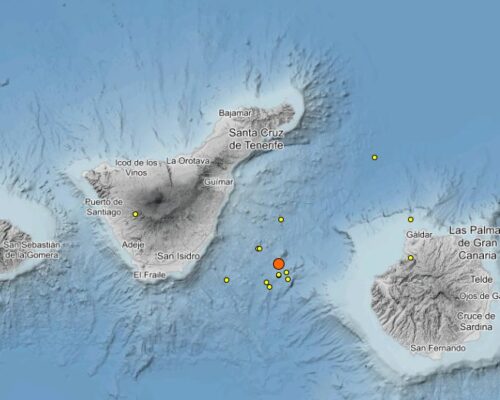
10 days of seismic activity around Tenerife ( 22nd February-4th March); yellow circles are earthquakes with a magnitude less than 2, orange between 2-3. Sourced from the IGN Seismic Visualiser (2026)
IGN Earthquake visualisor
Línea temporal de eventos volcánicos
Desplazarse la línea temporal para consultar actualizaciones anteriores.

Seismic swarm in Las Cañadas del Teide
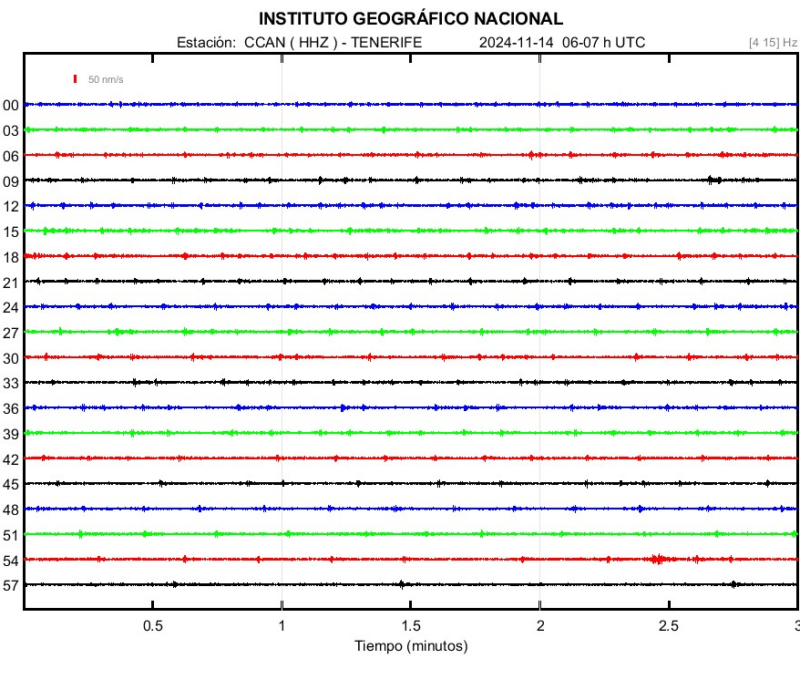
🇬🇧 🇺🇸 On 14 November 2024, more than 500 earthquakes were detected in the Cañadas del Teide, southwest of Pico Viejo, in the same area where seismicity has been recorded in recent years (October 2016, June 2019 and June and July 2022). There were also additional earthquakes that were too small (low magnitude) to be located (IGN, 2024).
🇪🇸 🇮🇨 El 14 de noviembre de 2024 se detectaron más de 500 terremotos en las Cañadas del Teide, al suroeste de Pico Viejo, en la misma zona donde se ha registrado sismicidad en los últimos años (octubre de 2016, junio de 2019 y junio y julio de 2022). También se produjeron otros terremotos que fueron demasiado pequeños (baja magnitud) para ser localizados (IGN, 2024).
Detection of low-frequency signals in the interior of Tenerife
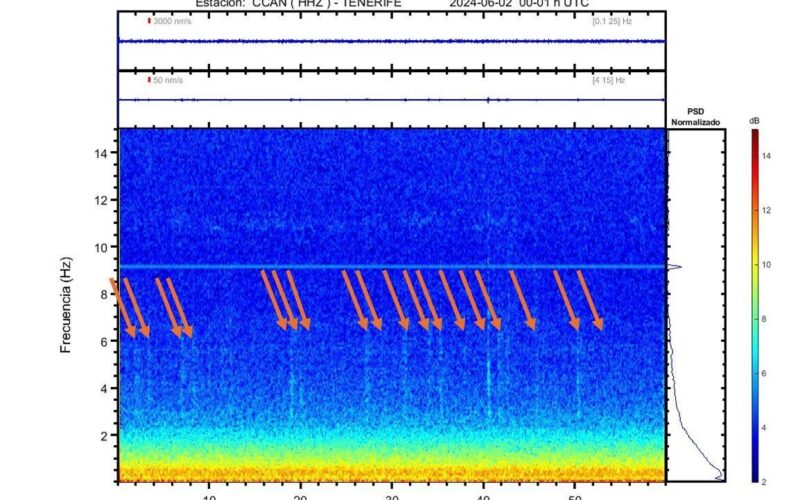
🇬🇧 🇺🇸 On 1st-2nd June 2024 at least 50 very small (low magnitude) earthquakes were detected below Tenerife, possibly under the Las Cañadas area. This type of low-frequency event is typically related to the presence of fluids, which usually refers to hydrothermal waters or fluids (like water or CO2) released from magma. (IGN, 2024).
🇪🇸 🇮🇨 Los días 1 y 2 de junio de 2024 se detectaron al menos 50 terremotos muy pequeños (de baja magnitud) bajo Tenerife, posiblemente bajo la zona de Las Cañadas. Este tipo de evento de baja frecuencia está normalmente relacionado con la presencia de fluidos, que suelen ser aguas hidrotermales o fluidos (como agua o CO2) liberados por el magma. (IGN, 2024).
Small seismic series 23-24th July in West Tenerife
🇬🇧 🇺🇸
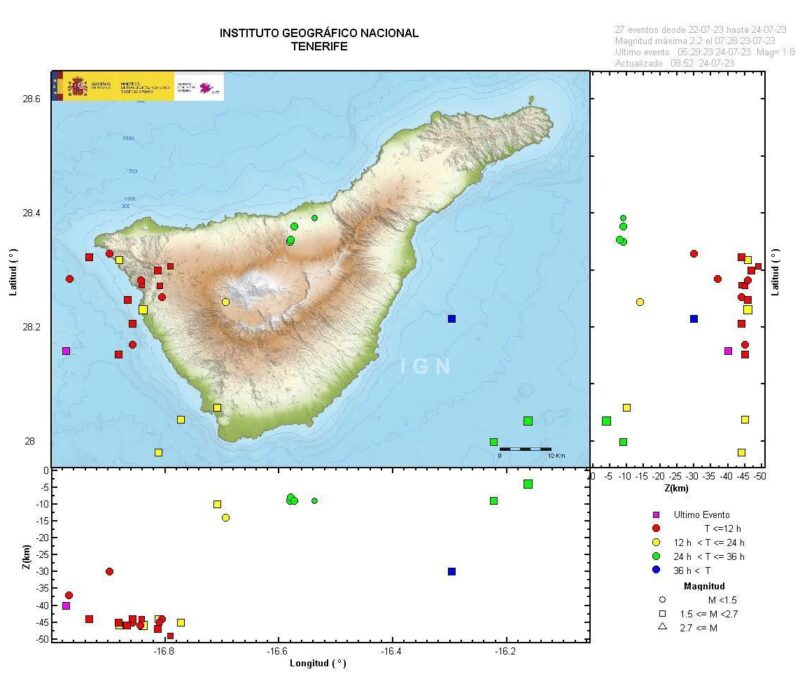
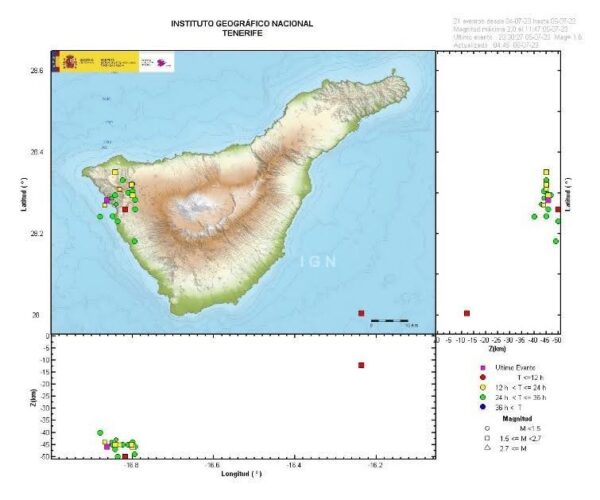
On 23-24 July 2023, a small seismic series of about 20 earthquakes occurred below the west coast of Tenerife. Most were 30 to 46 km deep, with magnitudes between 1.3 and 1.8 (mbLg), none of which were felt.
🇪🇸 🇮🇨
Los días 23 y 24 de julio de 2023, se produjo una pequeña serie sísmica de unos 20 terremotos bajo la costa occidental de Tenerife. La mayoría tuvieron una profundidad de entre 30 y 46 km, con magnitudes de entre 1,3 y 1,8 (mbLg), y ninguno de ellos se sintió.
New deep seismic series from Tenerife