
24 Mar Why do people return?
People returned to live in Pompeii. Now, they return to La Palma’s latest lava flows. It’s easy to see why.
Opinion piece
Ben Ireland, Volcanology PhD student and Lead Scientific Advisor, GeoTenerife
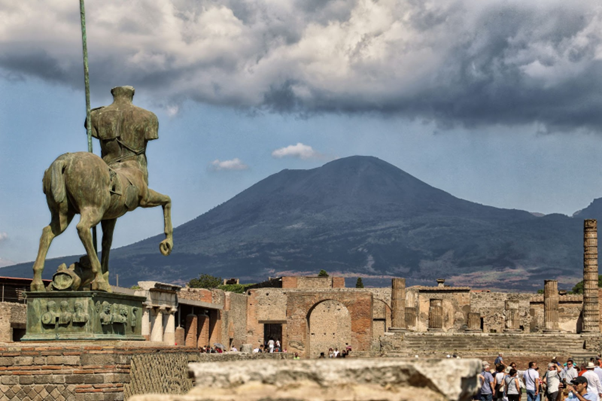
The ruins of Pompeii in the shadow of Mt Vesuvius. Photo credit: Iwona Castiello d’Antonio
A recent study presents evidence that some local people moved back to Pompeii quickly after the 79AD eruption of Mt Vesuvius that famously entombed the Roman city under violent pyroclastic flows. These findings generated considerable media coverage, with many questioning why people would return to the destroyed area. However, this is not the exception but rather the rule for anyone familiar with so-called ‘urban’ volcanic eruptions, and indeed, a portion of La Palma’s population is keen to remain in the Aridane valley, surrounded by the lava flows that took their homes away.
So why would people return to hazardous areas? As it turns out, there are more sensible, practical, and emotional reasons than you may think.
Firstly, for those affected by the eruption, looking for ease and certainty as they navigate a challenging recovery, it may simply be practical for them to remain close to where they were. Put yourself in the shoes of someone from the Aridane Valley who lost their home in the 2021 eruption. Your long-term priority is to find a permanent housing solution, presumably in an area with low volcanic hazard, but day-to-day, you still have to go to work, you may have children in school, and family members to take care of, all within the Aridane Valley. Even if you are offered alternative housing in a low-hazard area on the other side of La Palma, adding an hour or more onto commutes to work and school, from an unfamiliar town, may present too much of a challenge to take the offer.
This dynamic was borne out recently with 42 new homes built in Breña Baja for those affected, 40 minutes drive away from the Aridane Valley, which did not receive any uptake. The lack of appropriate housing solutions isn’t limited to location but also type of housing; Palmeros in the Aridane Valley traditionally live in low-density, semi-urban multi-generational ancestral homes with land and a few crops, but are now often being expected to move into new multi-storey flats in larger towns.
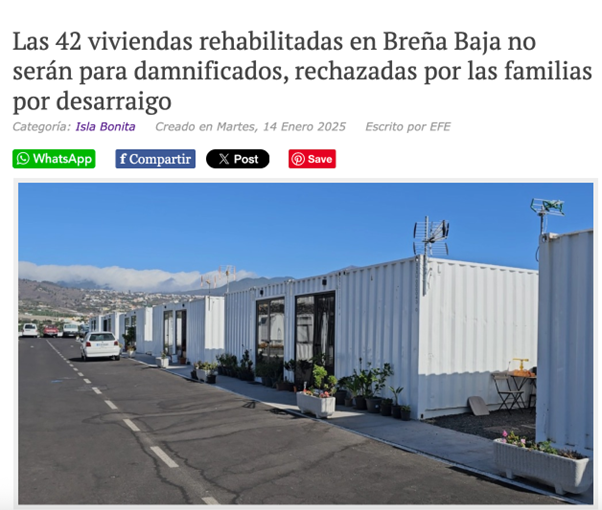
Screenshot of a news article about the 42 rejected homes in Breña Baja. Credit: El Time
A second important aspect is that many of those affected may lack the agency to make a move or rebuild elsewhere. This is a common theme in disasters worldwide, with the returners to Pompeii thought to be from the poorest groups in society, in the same way that those most impacted by climate change have the least resources to migrate elsewhere. In La Palma, many of those affected struggled to find somewhere else to stay if they could not rely on family and friends. There are many who are living in garages or caravans, relying on charities such as Caritas for support. This has been exacerbated by large rises in land prices driven by speculation, and a lack of supply of building materials and services due to the reconstruction.
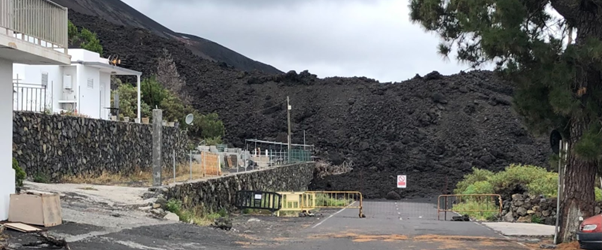
Part of the 2021 lava flows cut through roads and housing in Tajuya, La Palma. Photo credit: Ben Ireland
As well as practical reasons, there are also clear emotional motivations for many to stay in the Aridane Valley, despite its high volcanic hazard. A recent study led by GeoTenerife alumnus Rosie Rice investigated Palermo’s attachment to their communities and regions in relation to the 2021 eruption. They found Palmeros have a strong desire to rebuild in the Aridane Valley, in some cases directly on top of the 2021 lava flows, and this is motivated by their strong attachment to the area, to their communities, and the fear and uncertainty around rebuilding away from ‘home’. They also suggest that this strong attachment to place enhances feelings of loss and trauma associated with the eruption, strengthening the desire to return. As discussed in the article, this dynamic has also been seen in other disasters such as Hurricane Katrina, and can be seen in the political approach to recovery on La Palma, which now focuses on recovering things how it was before.
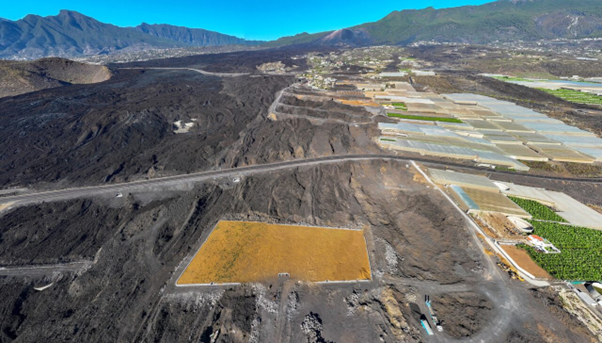
Farms, roads and tracks have been reconstructed on the 2021 lava flows. Photo credit: ILoveTheWorld
Finally, it’s worth remembering why populations settle in hazardous volcanic areas in the first place. Among other things, volcanoes offer fertile soils, mineral resources, and high biodiversity, which are routinely exploited across the globe. In La Palma, the soils have long been exploited for growing fruits and vegetables, especially bananas, which are a key export heavily subsidised by the European Union. Through the process of ‘sorriba’, which is unique to the Canary Islands, recent lava flows can be re-purposed into some of the most productive agricultural land on the island. With this incentive and the historical decadal return time between eruptions on La Palma, it’s clear why many choose to live there and accept the possibility of losing their homes to an eruption.
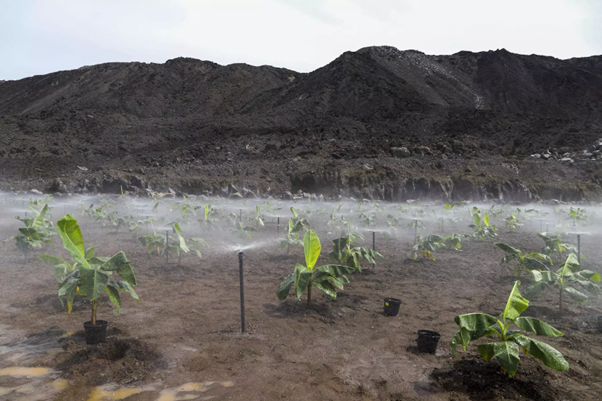
The first banana crops have been planted on farms built on top of the 2021 lava flows in La Palma. Photo credit: La Palma Ahora
In Hawaii, there is an implicit understanding among communities that Pele (the goddess of fire, lightning, wind, and volcanoes) both gives and takes away, exemplifying the acceptance of risk in living in a volcanic area, given its benefits. It seems clear that a similar sentiment, as well as people’s attachment to ‘home’ and a lack of resources to uproot, will continue to drive populations to remain in areas prone to a wide variety of environmental hazards.
References:
BBC News (2025) People returned to live in Pompeii’s ruins, archaeologists say. https://www.bbc.co.uk/news/articles/c62wx23y2v1o [Accessed 25.8.25]
El Diario (2024) Sembradas las primeras fincas de plátanos sobre las coladas del volcán de La Palma. https://www.eldiario.es/canariasahora/lapalmaahora/sociedad/sembradas-primeras-fincas-platanos-coladas-volcan-palma_1_11264337.html [Accessed 28.8.25]
El Diario (2025) Un modelo neoliberal que obvia el riesgo volcánico: un estudio analiza la “caótica” planificación de La Palma tras la erupción. https://www.eldiario.es/canariasahora/sociedad/modelo-neoliberal-obvia-riesgo-volcanico-estudio-analiza-caotica-planificacion-palma-erupcion_1_12284905.html [Accessed 26.8.25]
El Time (2023) El 43% de los afectados denuncia que sufre “precios especulativos” en alquileres, viviendas y terrenos. https://eltime.es/isla-bonita/43489-el-43-de-los-afectados-denuncia-que-sufre-precios-especulativos-en-alquileres-viviendas-y-terrenos.html [Accessed 27.8.25]
El Time (2024) Cáritas denuncia “un incremento en el número de personas sin hogar tras la erupción” y lamenta “la falta de viviendas sociales”. https://eltime.es/isla-bonita/51065-caritas-denuncia-un-incremento-en-el-numero-de-personas-sin-hogar-tras-la-erupcion-y-lamenta-la-falta-de-viviendas-sociales.html [Accessed 26.8.25]
El Time (2025) Las 42 viviendas rehabilitadas en Breña Baja no serán para damnificados, rechazadas por las familias por desarraigo. https://www.eltime.es/isla-bonita/51737-ningun-afectado-por-el-volcan-ha-aceptado-mudarse-a-las-viviendas-de-finca-amado.html [Accessed 26.8.25]
Pompeii Sites (2025) La rioccupazione nell’Insula meridionalis di Pompei dopo il 79 d.C. Riflessioni a margine dell’“inconscio archeologico”. https://pompeiisites.org/e-journal-degli-scavi-di-pompei/la-rioccupazione-nellinsula-meridionalis-di-pompei-dopo-il-79-d-c-riflessioni-a-margine-dellinconscio-archeologico/ [Accessed 25.8.25]
Rice, R., & Oppenheimer, C. (2025). Understanding Attachment to Place in the context of the 2021 Tajogaite eruption crisis and recovery, La Palma. Volcanica, 8(2), 357-367. http://dx.doi.org/10.30909/vol/ycys9674
No Comments