Current Reports of volcanic unrest in the Canary Islands

Introduction

The Canary Islands have had a lot of volcanic activity over millions of years, and some of the islands are still active today; therefore, there will likely be another eruption at some point, but it is near-impossible to predict exactly when, where, or how big it will be. Scientists closely watch the volcanoes to understand their normal “background” activity so that they can identify when unusual volcanic behaviour might indicate that an eruption could be on the way. On this page we describe who monitors volcanic activity and participates in emergency response with a timeline of the main episode of unrest in the last 20 years.

It is important to refer to official sites for information in an emergency. The main sites to find information around volcanic unrest are:

Twitter accounts of the Islands’ Cabildos:

Cabildo de Lanzarote

Cabildo de El Hierro

Cabildo de La Palma

Cabildo de Tenerife

Other groups also cover volcanic unrest:

Current status of each island

For an explanation of Traffic Light System, click here

The colours in this interactive map do NOT correspond to the Volcanic traffic level above. The most recent earthquake is within the flashing red circle. Yellow circles are earthquakes with a magnitude less than 2, orange between 2-3, red between 3-4, and dark red is a magnitude of more than 4. IGN Spain uses the mbLg, which measures the body wave magnitude, uses a logarithmic scale, and this scale is suited for measuring earthquakes close to their epicentre.

Most recent report

A summarised version of the most recent report available through the IGN seismic catalogue, relevant social media, and news articles. You can find a comprehensive timeline at the bottom of this page.

Preloader
  • Las Canadas del Teide, IGN report, February 12th 2026

    🇬🇧 🇺🇸 IGN detected a new seismic swarm event on the afternoon of 12th February, following days of seismic activity; 876 individual quakes were recorded at approximately 8 km depth in the Western sector of Las Cañadas del Teide. This is the same region where similar seismic events have been recorded since 2016. This new activity is of particularly low magnitude, with the maximum seismic event recorded at 0.7 mBlg (magnitude), which is usually not felt by the population. (IGN, 2026).

    🇪🇸 🇮🇨 El IGN detectó un nuevo evento sísmico en la tarde del 12 de febrero, tras varios días de actividad sísmica; se registraron 876 temblores individuales a aproximadamente 8 km de profundidad en el sector occidental de Las Cañadas del Teide. Se trata de la misma región en la que se han registrado eventos sísmicos similares desde 2016. Esta nueva actividad es de magnitud particularmente baja, con el evento sísmico máximo registrado en 0,7 mBlg (magnitud), lo que normalmente no es percibido por la población (IGN, 2026).

Timeline of volcanic unrest

Drag the timeline along to see previous updates

September 1 2025 2:38 PM

Volcanic eruption drill

🇬🇧 In Tenerife we have been working on a serious, real and useful volcanic safety plan for two years.

 From 23 to 26 September we will do something historic:

  • An unprecedented volcanic eruption drill in Spain.

  • Emergency teams, scientists, volunteers and all municipalities will participate.

On Thursday 26th, at 9.00h, you will receive a test alert message on your mobile. It’s just a test. There is no emergency.

We want you to know:

  • How to act

  • Where to go out

  • Where to meet

  • How to prepare your backpack

  • What to do with your pets

  • Who to listen to and where to inform

    Because when we know what to do, everything is easier.

🇪🇸 🇮🇨 En Tenerife llevamos dos años trabajando en un plan de seguridad volcánica serio, real y útil.
Del 23 al 26 de septiembre haremos algo histórico:

  • Un simulacro sobre erupción volcánica que no tiene precedentes en España.

  • Participarán equipos de emergencia, científicos, voluntarios y todos los municipios.

El jueves 26, a las 9.00 h, recibirás un mensaje de alerta de prueba en tu móvil. Es solo una prueba. No hay emergencia.

Queremos que sepas:

  • Cómo actuar.

  • Por dónde salir.

  • Dónde reunirte.

  • Cómo preparar tu mochila.

  • Qué hacer con tus mascotas.

  • A quién escuchar y dónde informarte.

Porque cuando sabemos qué hacer, todo es más fácil.

@rosa_davilamamely

August 6 2025 9:30 PM

2 seismic swarms recorded under the Teide-Pico Viejo complex

🇬🇧 🇺🇸 Sixth seismic swarm detected in #Tenerife since 2016

Since 02:00 (UTC) this morning, a swarm of anomalous microseismic activity has been recorded in the Las Cañadas del Teide area, southwest of Pico Viejo.

So far, more than 700 small #earthquakes have been recorded, concentrated in this same area, where similar episodes had already been observed in recent years (October 2016, June 2019, June and July 2022, and November 2024).

The seismic events are located at a depth of about 10 km and have very low magnitudes, below 1. Therefore, they have not been felt by the population.

🇪🇸 🇮🇨 Sexto enjambre sísmico detectado en #Tenerife desde 2016

Desde las 02:00 (UTC) de la madrugada de hoy se ha registrado un enjambre de actividad microsísmica anómala en la zona de Las Cañadas del Teide, al suroeste de Pico Viejo.

Hasta el momento se han registrado más de 700 pequeños #terremotos concentrados en esta misma área, donde en los últimos años ya se habían observado episodios similares (octubre de 2016, junio de 2019, junio y julio de 2022, y noviembre de 2024).

Los eventos sísmicos se localizan a unos 10 km de profundidad y presentan magnitudes muy bajas, inferiores a 1. Por tanto, no han sido sentidos por la población.

IGN

August 6 2025 9:30 PM

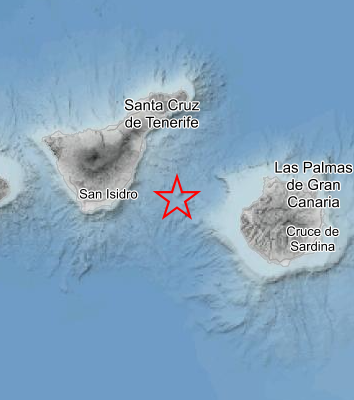
3.3 mbLg earthquake 65 km north of Tenerife

Sourced from IGN (2-25)

🇬🇧 🇺🇸 At 07:44 am local time, IGN detected a 3.3 mbLg earthquake 75 km north of Santa Cruz, Tenerife. The earthquake occurred at a depth of 47 km. This follows an earthquake of 2.9 mbLg which occurred yesterday 110 km North of Santa Cruz, 5th February 2025, at 03:51 am at a depth of 75 km into the earth.

Read more here

🇪🇸 🇮🇨A las 07:44 a. m., hora local, IGN detectó un terremoto de 3,3 mbLg a 75 km al norte de Santa Cruz, Tenerife. El terremoto se produjo a una profundidad de 47 km. Esto sigue a un terremoto de 2,9 mbLg que ocurrió ayer 110 km al norte de Santa Cruz, el 5 de febrero de 2025, a las 03:51 a. m. a una profundidad de 75 km en la tierra.

Más información en IGN

January 24 2025 1:00 PM

GeoTenerife twitter thread

Posting to Twitter and Bluesky, GeoTenerife breaks down the recent Pevolca press release, explaining what it means and why it’s relevant to residents and tourists on the island of Tenerife. We also used this opportunity to show where resources regarding eruption preparedness can be found, including the Tenerife emergency plans openly accessible on our Volcanic Readiness page.

🇪🇸

🇬🇧

January 23 2025 2:00 PM

PEVOLCA scientists agree on the “anomalous” activity of Teide, although there are no signs of an eruption

PEVOLCA meeting on January 23rd 2025. Sourced from Gobierno de Canarias (2025)

🇬🇧 🇺🇸 Experts from the Scientific Committee for the Evaluation and Monitoring of Volcanic Phenomena (CCES), provided for in the Special Plan for Civil Protection and Emergency Response due to volcanic risk in the Autonomous Community of the Canary Islands (PEVOLCA), agree in describing the volcanic activity of Teide as “anomalous”, although the signs “do not seem to be precursors of an eruptive process in the short term, but they do imply an increase in the probability of it occurring in the medium to long term”. (Gobierno de Canarias, 2025)

🇪🇸 🇮🇨 Los expertos del Comité Científico de Evaluación y Seguimiento de Fenómenos Volcánicos (CCES), previsto en el Plan Especial de Protección Civil y Atención de Emergencias por riesgo volcánico en la Comunidad Autónoma de Canarias (PEVOLCA), coinciden en calificar como “anómala” la actividad volcánica del Teide, aunque los indicios “no parecen ser precursores de un proceso eruptivo a corto plazo, pero sí suponen un aumento en la probabilidad de que se produzca a medio largo plazo”. (Gobierno de Canarias, 2025)