Introduction
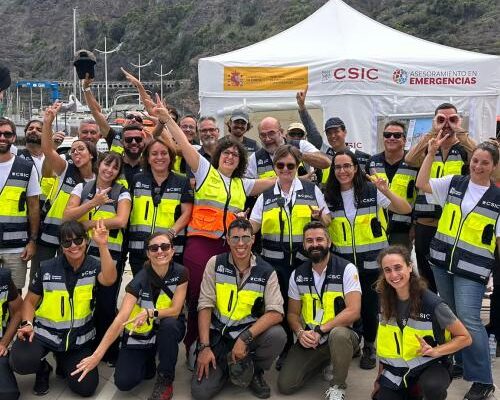
The Canary Islands have had a lot of volcanic activity over millions of years, and some of the islands are still active today; therefore, there will likely be another eruption at some point, but it is near-impossible to predict exactly when, where, or how big it will be. Scientists closely watch the volcanoes to understand their normal “background” activity so that they can identify when unusual volcanic behaviour might indicate that an eruption could be on the way. On this page we describe who monitors volcanic activity and participates in emergency response with a timeline of the main episode of unrest in the last 20 years.
It is important to refer to official sites for information in an emergency. The main sites to find information around volcanic unrest are:
Twitter accounts of the Islands’ Cabildos:
Cabildo de Lanzarote
Cabildo de El Hierro
Cabildo de La Palma
Cabildo de Tenerife
Other groups also cover volcanic unrest:
Current status of each island
VTL - Current volcanic traffic level by Ajay Geotenerife
For an explanation of Traffic Light System, click here
The colours in this interactive map do NOT correspond to the Volcanic traffic level above. The most recent earthquake is within the flashing red circle. Yellow circles are earthquakes with a magnitude less than 2, orange between 2-3, red between 3-4, and dark red is a magnitude of more than 4. IGN Spain uses the mbLg, which measures the body wave magnitude, uses a logarithmic scale, and this scale is suited for measuring earthquakes close to their epicentre.
Most recent report
A summarised version of the most recent report available through the IGN seismic catalogue, relevant social media, and news articles. You can find a comprehensive timeline at the bottom of this page.

New research about Volcan Enmedio
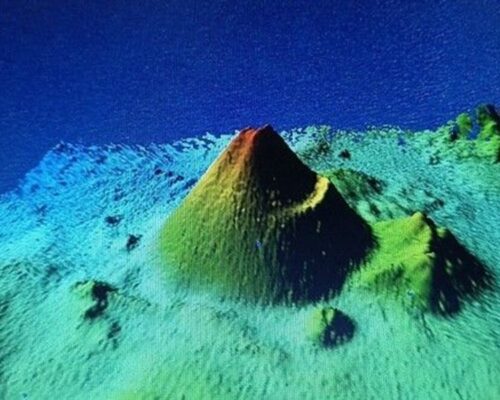
🇬🇧 🇺🇸 The Enmedio submarine volcano, located between the islands of Tenerife and Gran Canaria and more than 1,600 meters deep, exhibits active hydrothermal fluid circulation. A scientific team from the Spanish Institute of Oceanography (IEO), and in collaboration with Geosciences Barcelona (GEO3BCN-CSIC), the Institute of Marine Sciences (ICM-CSIC), the University of Salamanca (USAL), and the University of La Laguna (ULL), has published a paper in the Bulletin of Volcanology, available here, expanding upon geological, geophysical, geochemical and oceanographic data collected over almost a decade. Whilst this analysis provides key information for understanding submarine volcanism in the Canary Islands and its interaction with the ocean, it is not related to the seismic swarms recorded last week in Las Cañadas del Teide.
🇪🇸 🇮🇨El volcán submarino Enmedio, situado entre las islas de Tenerife y Gran Canaria y a más de 1600 metros de profundidad, presenta una circulación activa de fluidos hidrotermales. Un equipo científico del Instituto Español de Oceanografía (IEO), en colaboración con Geociencias Barcelona (GEO3BCN-CSIC), el Instituto de Ciencias del Mar (ICM-CSIC), la Universidad de Salamanca (USAL) y la Universidad de La Laguna (ULL), ha publicado un artículo en el Boletín de Vulcanología, disponible aquí, en el que se amplían los datos geológicos, geofísicos, geoquímicos y oceanográficos recopilados durante casi una década. Si bien este análisis proporciona información clave para comprender el vulcanismo submarino en las Islas Canarias y su interacción con el océano, no está relacionado con los enjambres sísmicos registrados la semana pasada en Las Cañadas del Teide.
Timeline of volcanic unrest
Drag the timeline along to see previous updates

Las Cañadas del Teide, Pevolca report, 10th February 2026
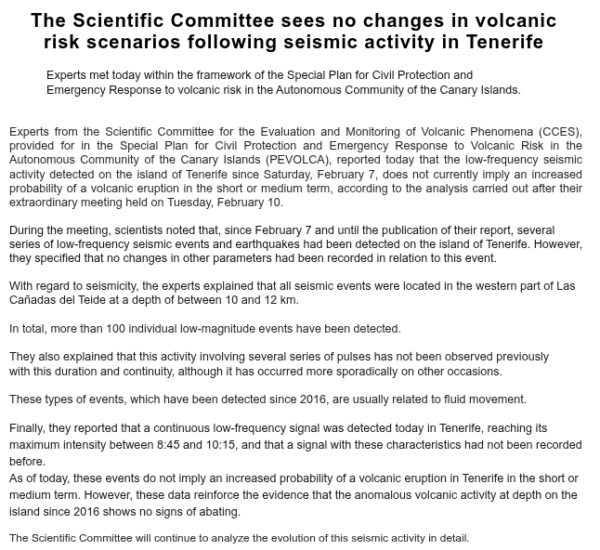
🇬🇧 🇺🇸 The Pevolca report explains that, since February 7, 2026, there have been more than 100 series of low-frequency seismic events. However, their nature, depth, and location represent typical activity for Teide.
PEVOLCA also reports that today (February 10, 2026), a continuous low-frequency signal has been detected in Tenerife, reaching its maximum intensity between 8:45 and 10:15 a.m., and that a signal with these characteristics has never been recorded before. PEVOLCA assures that these events do not imply an increased probability of a volcanic eruption in Tenerife in the short or medium term. (Government of the Canary Islands, 2026)
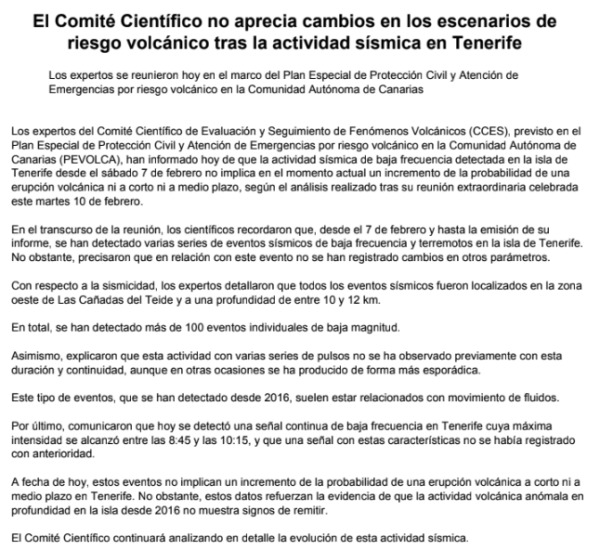
🇪🇸 🇮🇨 El informe del Pevolca explica que, desde el 7 de febrero de 2026, se han producido más de 100 series de eventos sísmicos de baja frecuencia. Sin embargo, su naturaleza, profundidad y ubicación representan una actividad típica del Teide.
PEVOLCA también informa de que hoy (10 de febrero de 2026) se ha detectado en Tenerife una señal continua de baja frecuencia, que ha alcanzado su máxima intensidad entre las 8:45 y las 10:15 de la mañana, y que nunca antes se había registrado una señal con estas características. El PEVOLCA asegura que estos eventos no implican un aumento de la probabilidad de una erupción volcánica en Tenerife a corto o medio plazo. (Gobierno de Canarias, 2026)
VOLCAN
🇬🇧 🇺🇸 The European project VOLCAN has now been funded. The aim of this European Commission-funded project is to provide technical assistance to the disaster risk management authorities of the Canary Islands (Civil Protection, First Responders, local governments and municipalities) to revise the Special Plan for Civil Protection and Volcanic Risk Emergency in the Autonomous Community of the Canary Islands (PEVOLCA) (Government of the Canary Islands, 2025). PEVOLCA was initially approved in 2010, revised in 2018, but will be further adapted after the experience gained during the management of the La Palma eruption in 2021 (VOLCAN 2025).
🇪🇸 🇮🇨 El proyecto europeo VOLCAN ya ha recibido financiación. El objetivo de este proyecto, financiado por la Comisión Europea, es prestar asistencia técnica a las autoridades de gestión del riesgo de desastres de las Islas Canarias (Protección Civil, equipos de primera intervención, gobiernos locales y municipios) para revisar el Plan Especial de Protección Civil y Emergencias por Riesgo Volcánico de la Comunidad Autónoma de Canarias (PEVOLCA) (Gobierno de Canarias, 2025). El PEVOLCA se aprobó inicialmente en 2010, se revisó en 2018, pero se adaptará aún más tras la experiencia adquirida durante la gestión de la erupción de La Palma en 2021 (VOLCAN, 2025).