
Acceda a esta página en español:

Current Reports of volcanic unrest in the Canary Islands

Introduction

The Canary Islands have had a lot of volcanic activity over millions of years, and some of the islands are still active today; therefore, there will likely be another eruption at some point, but it is near-impossible to predict exactly when, where, or how big it will be. Scientists closely watch the volcanoes to understand their normal “background” activity so that they can identify when unusual volcanic behaviour might indicate that an eruption could be on the way. On this page we describe who monitors volcanic activity and participates in emergency response with a timeline of the main episode of unrest in the last 20 years.

It is important to refer to official sites for information in an emergency. The main sites to find information around volcanic unrest are:

Twitter accounts of the Islands’ Cabildos:

Cabildo de Lanzarote

Cabildo de El Hierro

Cabildo de La Palma

Cabildo de Tenerife

Other groups also cover volcanic unrest:

Current status of each island

For an explanation of Traffic Light System, click here

The colours in this interactive map do NOT correspond to the Volcanic traffic level above. The most recent earthquake is within the flashing red circle. Yellow circles are earthquakes with a magnitude less than 2, orange between 2-3, red between 3-4, and dark red is a magnitude of more than 4. IGN Spain uses the mbLg, which measures the body wave magnitude, uses a logarithmic scale, and this scale is suited for measuring earthquakes close to their epicentre.

Most recent report

A summarised version of the most recent report available through the IGN seismic catalogue, relevant social media, and news articles. You can find a comprehensive timeline at the bottom of this page.

Preloader
  • Las Cańadas activity, IGN Report, March 13-16th

    🇬🇧 🇺🇸 The seismic activity, low magnitude events occurring between 8-21 km below sea level, recorded in Las Cañadas since February this year, continues, although at lower levels than early March. This week, no swarms of repetitive quakes were observed. However, 2 bursts of low-frequency quakes were observed on the 14th and 15th.  IGN notes that this activity does not increase the risk of an eruption in the short to medium term on Tenerife. IGN continues to monitor their extensive network for changes and anomalies. (IGN, 2026)

    🇪🇸 🇮🇨 La actividad sísmica, consistente en eventos de baja magnitud que se producen entre 8 y 21 km por debajo del nivel del mar, registrada en Las Cañadas desde febrero de este año, continúa, aunque a niveles más bajos que a principios de marzo. Esta semana no se han observado enjambres de temblores repetitivos. Sin embargo, los días 14 y 15 se observaron dos ráfagas de terremotos de baja frecuencia. El IGN señala que esta actividad no aumenta el riesgo de erupción a corto o medio plazo en Tenerife. El IGN sigue vigilando su amplia red en busca de cambios y anomalías. (IGN, 2026)

Timeline of volcanic unrest

Drag the timeline along to see previous updates

February 10 2026 2:00 PM

Las Cañadas del Teide, Pevolca report, 10th February 2026

🇬🇧 🇺🇸 The Pevolca report explains that, since February 7, 2026, there have been more than 100 series of low-frequency seismic events. However, their nature, depth, and location represent typical activity for Teide.

PEVOLCA also reports that today (February 10, 2026), a continuous low-frequency signal has been detected in Tenerife, reaching its maximum intensity between 8:45 and 10:15 a.m., and that a signal with these characteristics has never been recorded before. PEVOLCA assures that these events do not imply an increased probability of a volcanic eruption in Tenerife in the short or medium term. (Government of the Canary Islands, 2026)
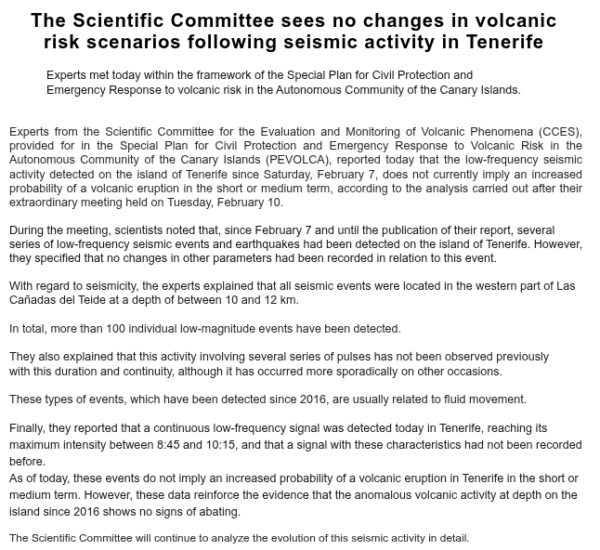
Click on the image to read the official report

🇪🇸 🇮🇨 El informe del Pevolca explica que, desde el 7 de febrero de 2026, se han producido más de 100 series de eventos sísmicos de baja frecuencia. Sin embargo, su naturaleza, profundidad y ubicación representan una actividad típica del Teide.

PEVOLCA también informa de que hoy (10 de febrero de 2026) se ha detectado en Tenerife una señal continua de baja frecuencia, que ha alcanzado su máxima intensidad entre las 8:45 y las 10:15 de la mañana, y que nunca antes se había registrado una señal con estas características. El PEVOLCA asegura que estos eventos no implican un aumento de la probabilidad de una erupción volcánica en Tenerife a corto o medio plazo. (Gobierno de Canarias, 2026)
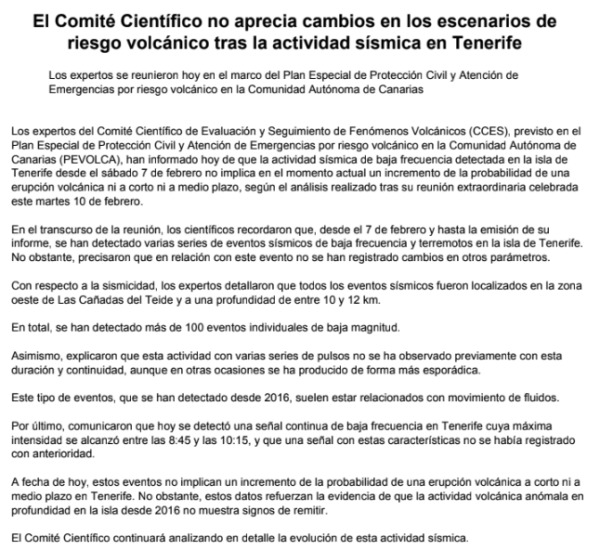
Haga clic en la imagen para leer el informe oficial.
February 7 2026 2:00 PM

Las Canadas del Teide, IGN report, February 7th 2026

🇬🇧 🇺🇸 Since Saturday, 7 February, the National Geographic Institute (IGN) has recorded several series of seismic events in the Las Cañadas del Teide area. Many of the quakes are located in the western sector, 10-12 km deep; an area where similar episodes have been observed in recent years. This type of seismic signal is usually associated with fluid movement at depth, a common process in active volcanic systems such as Tenerife.

The advisory committee of the Special Plan for Civil Protection and Emergency Response for Volcanic Risk in the Canary Islands Autonomous Community (PEVOLCA) met on Tuesday, 10th February; however, with the information available at this time, the IGN sees no evidence of a significant change in the state of the volcanic system (IGN, 2026).

🇪🇸 🇮🇨 Desde el sábado 7 de febrero, el Instituto Geográfico Nacional (IGN) ha registrado varias series de eventos sísmicos en la zona de Las Cañadas del Teide. Muchos de los terremotos se localizan en el sector occidental, a una profundidad de entre 10 y 12 km, una zona en la que se han observado episodios similares en los últimos años. Este tipo de señal sísmica suele estar asociada al movimiento de fluidos en profundidad, un proceso habitual en sistemas volcánicos activos como el de Tenerife.

El comité consultivo del Plan Especial de Protección Civil y de Emergencia por Riesgo Volcánico de la Comunidad Autónoma de Canarias (PEVOLCA) se reunió el martes 10 de febrero; sin embargo, Con la información disponible en este momento, el IGN no ve indicios de un cambio significativo en el estado del sistema volcánico. (IGN, 2026).

January 31 2026 12:00 PM

VOLCAN

🇬🇧 🇺🇸 The European project VOLCAN has now been funded. The aim of this  European Commission-funded project is to provide technical assistance to the disaster risk management authorities of the Canary Islands (Civil Protection, First Responders, local governments and municipalities) to revise the Special Plan for Civil Protection and Volcanic Risk Emergency in the Autonomous Community of the Canary Islands (PEVOLCA) (Government of the Canary Islands, 2025). PEVOLCA was initially approved in 2010, revised in 2018, but will be further adapted after the experience gained during the management of the La Palma eruption in 2021 (VOLCAN 2025).

🇪🇸 🇮🇨 El proyecto europeo VOLCAN ya ha recibido financiación. El objetivo de este proyecto, financiado por la Comisión Europea, es prestar asistencia técnica a las autoridades de gestión del riesgo de desastres de las Islas Canarias (Protección Civil, equipos de primera intervención, gobiernos locales y municipios) para revisar el Plan Especial de Protección Civil y Emergencias por Riesgo Volcánico de la Comunidad Autónoma de Canarias (PEVOLCA) (Gobierno de Canarias, 2025). El PEVOLCA se aprobó inicialmente en 2010, se revisó en 2018, pero se adaptará aún más tras la experiencia adquirida durante la gestión de la erupción de La Palma en 2021 (VOLCAN, 2025).
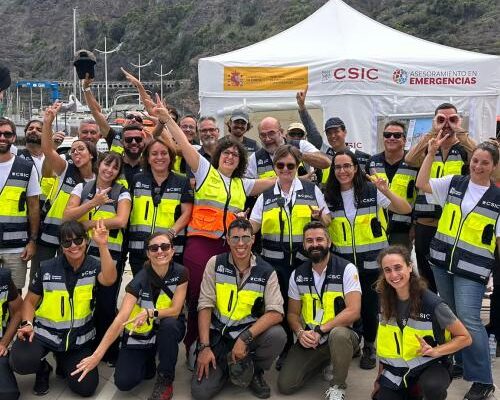
Members who attended the VOLCAN run simulation. Sourced from (VOLCAN, 2025)
September 1 2025 2:38 PM

Volcanic eruption drill

🇬🇧 In Tenerife we have been working on a serious, real and useful volcanic safety plan for two years.

 From 23 to 26 September we will do something historic:

  • An unprecedented volcanic eruption drill in Spain.

  • Emergency teams, scientists, volunteers and all municipalities will participate.

On Thursday 26th, at 9.00h, you will receive a test alert message on your mobile. It’s just a test. There is no emergency.

We want you to know:

  • How to act

  • Where to go out

  • Where to meet

  • How to prepare your backpack

  • What to do with your pets

  • Who to listen to and where to inform

    Because when we know what to do, everything is easier.

🇪🇸 🇮🇨 En Tenerife llevamos dos años trabajando en un plan de seguridad volcánica serio, real y útil.
Del 23 al 26 de septiembre haremos algo histórico:

  • Un simulacro sobre erupción volcánica que no tiene precedentes en España.

  • Participarán equipos de emergencia, científicos, voluntarios y todos los municipios.

El jueves 26, a las 9.00 h, recibirás un mensaje de alerta de prueba en tu móvil. Es solo una prueba. No hay emergencia.

Queremos que sepas:

  • Cómo actuar.

  • Por dónde salir.

  • Dónde reunirte.

  • Cómo preparar tu mochila.

  • Qué hacer con tus mascotas.

  • A quién escuchar y dónde informarte.

Porque cuando sabemos qué hacer, todo es más fácil.

@rosa_davilamamely

August 6 2025 9:30 PM

2 seismic swarms recorded under the Teide-Pico Viejo complex

🇬🇧 🇺🇸 Sixth seismic swarm detected in #Tenerife since 2016

Since 02:00 (UTC) this morning, a swarm of anomalous microseismic activity has been recorded in the Las Cañadas del Teide area, southwest of Pico Viejo.

So far, more than 700 small #earthquakes have been recorded, concentrated in this same area, where similar episodes had already been observed in recent years (October 2016, June 2019, June and July 2022, and November 2024).

The seismic events are located at a depth of about 10 km and have very low magnitudes, below 1. Therefore, they have not been felt by the population.

🇪🇸 🇮🇨 Sexto enjambre sísmico detectado en #Tenerife desde 2016

Desde las 02:00 (UTC) de la madrugada de hoy se ha registrado un enjambre de actividad microsísmica anómala en la zona de Las Cañadas del Teide, al suroeste de Pico Viejo.

Hasta el momento se han registrado más de 700 pequeños #terremotos concentrados en esta misma área, donde en los últimos años ya se habían observado episodios similares (octubre de 2016, junio de 2019, junio y julio de 2022, y noviembre de 2024).

Los eventos sísmicos se localizan a unos 10 km de profundidad y presentan magnitudes muy bajas, inferiores a 1. Por tanto, no han sido sentidos por la población.

IGN