
Introduction
The Canary Islands have had a lot of volcanic activity over millions of years, and some of the islands are still active today; therefore, there will likely be another eruption at some point, but it is near-impossible to predict exactly when, where, or how big it will be. Scientists closely watch the volcanoes to understand their normal “background” activity so that they can identify when unusual volcanic behaviour might indicate that an eruption could be on the way. On this page we describe who monitors volcanic activity and participates in emergency response with a timeline of the main episode of unrest in the last 20 years.
It is important to refer to official sites for information in an emergency. The main sites to find information around volcanic unrest are:
Twitter accounts of the Islands’ Cabildos:
Cabildo de Lanzarote
Cabildo de El Hierro
Cabildo de La Palma
Cabildo de Tenerife
Other groups also cover volcanic unrest:
Current status of each island
VTL - Current volcanic traffic level by Ajay Geotenerife
For an explanation of Traffic Light System, click here
The colours in this interactive map do NOT correspond to the Volcanic traffic level above. The most recent earthquake is within the flashing red circle. Yellow circles are earthquakes with a magnitude less than 2, orange between 2-3, red between 3-4, and dark red is a magnitude of more than 4. IGN Spain uses the mbLg, which measures the body wave magnitude, uses a logarithmic scale, and this scale is suited for measuring earthquakes close to their epicentre.
Most recent report
A summarised version of the most recent report available through the IGN seismic catalogue, relevant social media, and news articles. You can find a comprehensive timeline at the bottom of this page.

Las Cańadas activity calms for now, March 1st 2026
🇬🇧 🇺🇸 Seismic activity has eased in the Las Cańadas caldera, with only low-energy, low-frequency tremors recorded since February 28th. Furthermore, the last swarm that occurred on Thursday, 26th, was the ‘weakest’ swarm since the swarms were detected last month. (Canarian Weekly, 2026)
🇪🇸 🇮🇨La actividad sísmica ha disminuido en la caldera de Las Cañadas, y desde el 28 de febrero solo se han registrado temblores de baja energía y baja frecuencia. Además, el último enjambre que se produjo el jueves 26 fue el más «débil» desde que se detectaron los enjambres el mes pasado. (Canarian Weekly, 2026)
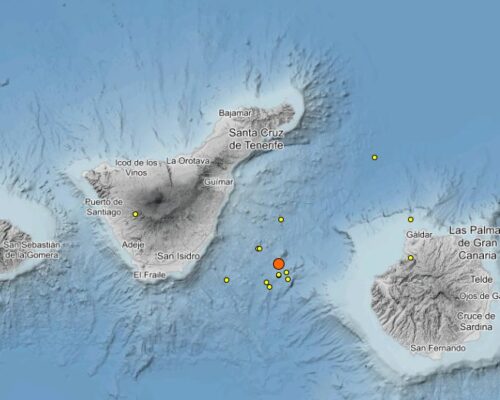
10 days of seismic activity around Tenerife ( 22nd February-4th March); yellow circles are earthquakes with a magnitude less than 2, orange between 2-3. Sourced from the IGN Seismic Visualiser (2026)
IGN Earthquake visualisor
Timeline of volcanic unrest
Drag the timeline along to see previous updates

Teide degassed more than usual June-October 2016
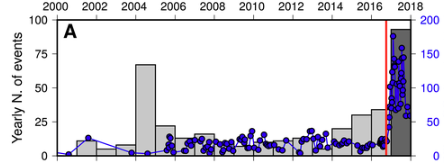
🇬🇧 🇺🇸 From June through August 2016 there was a change in degassing at Teide, including increased H₂S (hydrogen sulfide) emission. On the 2nd of October, a seismic swarm occurred over five hours, with at least 766 earthquakes detected. The swarm was followed by an increase in diffuse CO2 emission and by an increase in volcano-tectonic seismicity. These changes suggest magma was rising deep below and releasing fluids into the shallow hydrothermal system.
🇪🇸 🇮🇨 De junio a agosto de 2016 se produjo un cambio en la desgasificación del Teide, que incluyó un aumento de las emisiones de H₂S (sulfuro de hidrógeno). El 2 de octubre se produjo un enjambre sísmico durante cinco horas, con al menos 766 terremotos detectados. El enjambre fue seguido por un aumento de las emisiones difusas de CO2 y un aumento de la sismicidad vulcanotectónica. Estos cambios sugieren que el magma estaba subiendo desde las profundidades y liberando fluidos en el sistema hidrotermal superficial.
References
D’Auria, L., Barrancos, J., Padilla, G.D., Pérez, N.M., Hernández, P.A., Melián, G., Padrón, E., Asensio‐Ramos, M. and García‐Hernández, R., 2019. The 2016 Tenerife (Canary Islands) long‐period seismic swarm. Journal of Geophysical Research: Solid Earth, 124(8), pp.8739-8752.
Padrón, E., Pérez, N.M., Hernández, P.A., Melián, G., Asensio‐Ramos, M., D’Auria, L., Rodríguez, F., Alonso, M., Amonte, C., Padilla, G.D. and Barrancos, J., 2021. Changes in diffuse degassing from the summit crater of Teide volcano (Tenerife, Canary Islands) prior to the 2016 Tenerife long‐period seismic swarm. Journal of Geophysical Research: Solid Earth, 126(3), p.e2020JB020318.
2004-2005 Period of Volcanic Unrest
🇬🇧 🇺🇸
After the 2004-2005 unrest period (activity below the surface but no eruption) there have been studies published that have investigated the signals detected at Teide, gaining more clarity with hindsight and having time to compare the different types of monitoring data. Putting the data together, the interpretation is that there was a magmatic intrusion under the NW part of Tenerife along with related hydrothermal activity.
From 2001 to 2003 small magma intrusions likely affected the hydrothermal system, seen by increasing CO2 and H2S at the summit of Teide. This also may have been degassing of deeper magma.
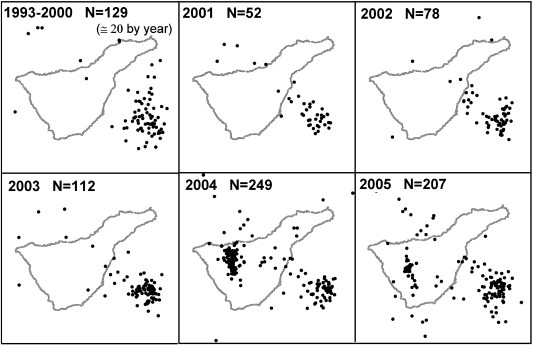
Beginning in late 2003, there was an increase in the number of earthquakes, or seismicity, detected below the island of Tenerife. This significantly increased early 2004. There had already been ongoing seismicity between Tenerife and Gran Canaria, but this was new for this location since modern volcano monitoring had commenced in 1992 by IGN and increasing in 2000.
Evidence for volcanic unrest included: 1) increased seismicity, 2) a significant increase in carbon dioxide (CO2) coming through the soil (diffuse, instead of a single point source like a fumarole) along the Santiago del Teide Ridge and around the Las Cañadas caldera; 3) an increased rate of CO2 emitted at Teide fumaroles; 4) traces of SO2 measured at Teide fumaroles; 5) increased fumarole activity at Teide; 6) a new fissure opened within the La Orotava valley with gas emissions; 7) changes in the gravity field that likely indicate moving hydrothermal fluids; and 8) minor ground deformation related to hydrothermal activity, only detected in hindsight.
🇪🇸 🇮🇨
Tras el periodo de inestabilidad de 2004-2005 (actividad bajo la superficie pero sin erupción), se han publicado estudios que han investigado las señales detectadas en el Teide, obteniendo más claridad en retrospectiva y teniendo tiempo para comparar los diferentes tipos de datos de monitorización. Al juntar los datos, la interpretación es que hubo una intrusión magmática bajo la parte noroeste de Tenerife junto con actividad hidrotermal relacionada.
Entre 2001 y 2003, pequeñas intrusiones de magma probablemente afectaron al sistema hidrotermal, lo que se vio por el aumento de CO2 y H2S en la cima del Teide. Esto también pudo haber sido la desgasificación de magma más profundo.
A partir de finales de 2003, se detectó un aumento en el número de terremotos, o sismicidad, debajo de la isla de Tenerife. Esto aumentó significativamente a principios de 2004. Ya había habido sismicidad continua entre Tenerife y Gran Canaria, pero esto era nuevo para esta ubicación, ya que el monitoreo moderno de volcanes había comenzado en 1992 por IGN y había aumentado en 2000.
Las pruebas de inestabilidad volcánica incluían: 1) aumento de la sismicidad, 2) aumento significativo del dióxido de carbono (CO2) que atraviesa el suelo (difuso, en lugar de una fuente puntual como una fumarola) a lo largo de la cordillera de Santiago del Teide y alrededor de la caldera de Las Cañadas; 3) aumento de la tasa de CO2 emitido en las fumarolas del Teide; 4) rastros de SO2 medidos en las fumarolas del Teide; 5) aumento de la actividad fumarólica en el Teide; 6) apertura de una nueva fisura en el valle de La Orotava con emisiones de gas; 7) cambios en el campo gravitatorio que probablemente indiquen el movimiento de fluidos hidrotermales; y 8) deformación menor del suelo relacionada con la actividad hidrotermal, detectada solo en retrospectiva.
References
Cerdeña, I.D., del Fresno, C. and Rivera, L., 2011. New insight on the increasing seismicity during Tenerife’s 2004 volcanic reactivation. Journal of Volcanology and Geothermal Research, 206(1-2), pp.15-29.
Galindo, I., 2005. Estructura volcano-tectónica y emisión difusa de gases de Tenerife (Islas Canarias). PhD Thesis, University of Barcelona, 350 pp.
García, A., Ortiz, R., Marrero, J.M., Sanchez, N., Vila, J., Correig, A.M., Marcià, R., Sleeman, R. and Tárraga, M., 2006. Monitoring the reawakening of Canary Islands’ Teide volcano. Eos, Transactions American Geophysical Union, 87(6), pp.61-65.
Gottsmann, J., Wooller, L., Martí, J., Fernández, J., Camacho, A.G., González, P.J., Garcia, A. and Rymer, H., 2006. New evidence for the reawakening of Teide volcano. Geophysical Research Letters, 33(20).
Martí, J., Ortiz, R., Gottsmann, J., Garcia, A. and De La Cruz-Reyna, S., 2009. Characterising unrest during the reawakening of the central volcanic complex on Tenerife, Canary Islands, 2004–2005, and implications for assessing hazards and risk mitigation. Journal of Volcanology and Geothermal Research, 182(1-2), pp.23-33.
Przeor, M., D’Auria, L., Pepe, S., Tizzani, P., Barone, A., Vitale, A., Pérez, N.M. and Castaldo, R., 2024. Independent component analysis and finite element modelling of the 2004–2005 ground deformation in Tenerife (Canary Islands). Frontiers in Earth Science, 12, p.1412827.