
Introduction
The Canary Islands have had a lot of volcanic activity over millions of years, and some of the islands are still active today; therefore, there will likely be another eruption at some point, but it is near-impossible to predict exactly when, where, or how big it will be. Scientists closely watch the volcanoes to understand their normal “background” activity so that they can identify when unusual volcanic behaviour might indicate that an eruption could be on the way. On this page we describe who monitors volcanic activity and participates in emergency response with a timeline of the main episode of unrest in the last 20 years.
It is important to refer to official sites for information in an emergency. The main sites to find information around volcanic unrest are:
Twitter accounts of the Islands’ Cabildos:
Cabildo de Lanzarote
Cabildo de El Hierro
Cabildo de La Palma
Cabildo de Tenerife
Other groups also cover volcanic unrest:
Current status of each island
VTL - Current volcanic traffic level by Ajay Geotenerife
For an explanation of Traffic Light System, click here
The colours in this interactive map do NOT correspond to the Volcanic traffic level above. The most recent earthquake is within the flashing red circle. Yellow circles are earthquakes with a magnitude less than 2, orange between 2-3, red between 3-4, and dark red is a magnitude of more than 4. IGN Spain uses the mbLg, which measures the body wave magnitude, uses a logarithmic scale, and this scale is suited for measuring earthquakes close to their epicentre.
Most recent report
A summarised version of the most recent report available through the IGN seismic catalogue, relevant social media, and news articles. You can find a comprehensive timeline at the bottom of this page.

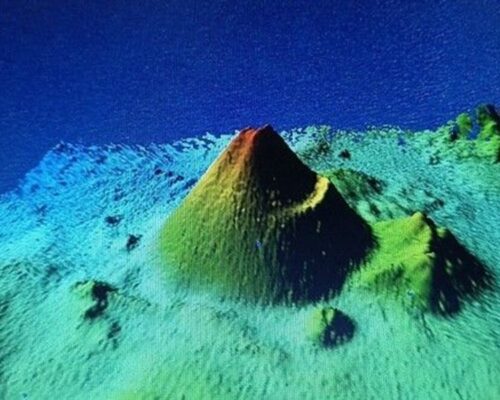
New research about Volcan Enmedio
🇬🇧 🇺🇸 The Enmedio submarine volcano, located between the islands of Tenerife and Gran Canaria and more than 1,600 meters deep, exhibits active hydrothermal fluid circulation. A scientific team from the Spanish Institute of Oceanography (IEO), and in collaboration with Geosciences Barcelona (GEO3BCN-CSIC), the Institute of Marine Sciences (ICM-CSIC), the University of Salamanca (USAL), and the University of La Laguna (ULL), has published a paper in the Bulletin of Volcanology, available here, expanding upon geological, geophysical, geochemical and oceanographic data collected over almost a decade. Whilst this analysis provides key information for understanding submarine volcanism in the Canary Islands and its interaction with the ocean, it is not related to the seismic swarms recorded last week in Las Cañadas del Teide.
🇪🇸 🇮🇨El volcán submarino Enmedio, situado entre las islas de Tenerife y Gran Canaria y a más de 1600 metros de profundidad, presenta una circulación activa de fluidos hidrotermales. Un equipo científico del Instituto Español de Oceanografía (IEO), en colaboración con Geociencias Barcelona (GEO3BCN-CSIC), el Instituto de Ciencias del Mar (ICM-CSIC), la Universidad de Salamanca (USAL) y la Universidad de La Laguna (ULL), ha publicado un artículo en el Boletín de Vulcanología, disponible aquí, en el que se amplían los datos geológicos, geofísicos, geoquímicos y oceanográficos recopilados durante casi una década. Si bien este análisis proporciona información clave para comprender el vulcanismo submarino en las Islas Canarias y su interacción con el océano, no está relacionado con los enjambres sísmicos registrados la semana pasada en Las Cañadas del Teide.
Timeline of volcanic unrest
Drag the timeline along to see previous updates

Microseismic activity in Las Cañadas del Teide
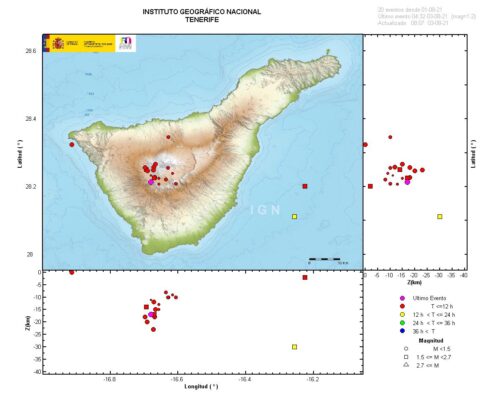
🇬🇧 🇺🇸
During 2-3 August 2021, small earthquakes were detected below Las Cañadas del Teide,mainly southwest of Pico Viejo and northeast of Guía de Isora, this is an area with a high level of microseismic activity detected and located on a regular basis.Of the 14 that were located, the magnitudes were between 0.6 and 1.9 (mbLg) and depths ranged between 8 and 23 km.
🇪🇸 🇮🇨
Durante los días 2 y 3 de agosto de 2021, se detectaron pequeños terremotos bajo Las Cañadas del Teide, principalmente al suroeste de Pico Viejo y al noreste de Guía de Isora, una zona con un alto nivel de actividad microsísmica detectada y localizada de forma regular. De los 14 que se localizaron, las magnitudes estaban entre 0,6 y 1,9 (mbLg) y las profundidades oscilaban entre 8 y 23 km.
Hybrid earthquakes located on the island of Tenerife
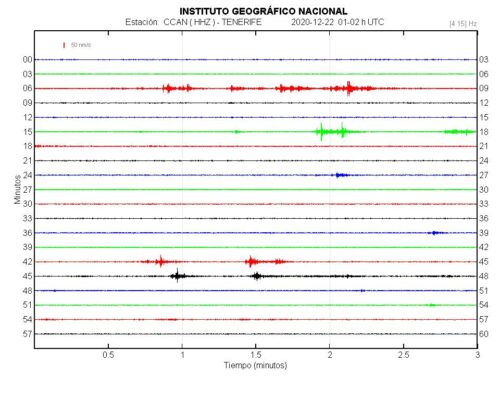
🇬🇧 🇺🇸
On 22 December 2020, 13 small earthquakes were detected below Tenerife. These “hybrid” earthquakes are characterised by a low-frequency signal. The 13 earthquakes were low magnitude (0.5 and 0.9 mbLg) and occurred at a depth of 13 km. Taking into account their locations, these earthquakes are likely associated with magmatic activity and are within the normal range of activity below the Teide-Pico Viejo
🇪🇸 🇮🇨
El 22 de diciembre de 2020, se detectaron 13 pequeños terremotos bajo Tenerife. Estos terremotos «híbridos» se caracterizan por una señal de baja frecuencia. Los 13 terremotos fueron de baja magnitud (0,5 y 0,9 mbLg) y ocurrieron a una profundidad de 13 km. Teniendo en cuenta sus ubicaciones, es probable que estos terremotos estén asociados con actividad magmática y se encuentren dentro del rango normal de actividad debajo del complejo Teide-Pico Viejo.
Earthquake felt across Tenerife
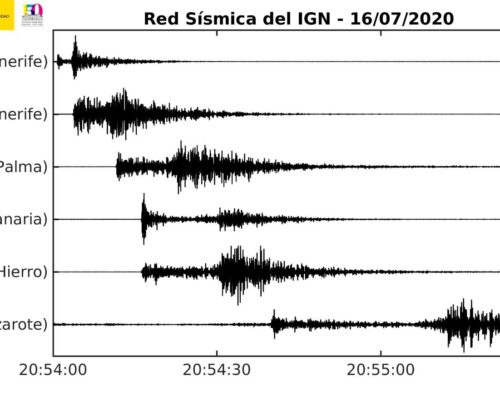
🇬🇧 🇺🇸
On 16 July 2020 at 20:53 a magnitude 4.0 (mbLg) earthquake occurred at a depth of 27 km, located below the area 3 km north of Punta del Casado, in Buenavista del Norte. The earthquake was widely felt throughout the island of Tenerife and even in towns on the islands of La Gomera and La Palma. The maximum intensity reached has been III-IV (EMS-98*) in the Tenerife towns of El Pozo (Guía de Isora), Fonsalía (Guía de Isora), La Vera (La Orotava), Las Longueras (La Guancha), Las Montañetas (La Guancha), on the island of La Gomera in Piedra Romana (Hermigua) and on the island of La Palma in Los Pedregales (El Paso). At the time of the report (11:30 on 17 July) there were no aftershocks detected.
This was a regional tectonic earthquake and was not related to fluid movement. Although there are few earthquakes located in this area, an earthquake of magnitude 3.7 Mw was located in this same area on 8 January 1990 at a depth of 39 km, which was felt with intensity III in the coastal towns of Buenavista del Norte.
🇪🇸 🇮🇨
El 16 de julio de 2020 a las 20:53 se produjo un terremoto de magnitud 4,0 (mbLg) a una profundidad de 27 km, situado debajo de la zona 3 km al norte de Punta del Casado, en Buenavista del Norte. El terremoto se sintió ampliamente en toda la isla de Tenerife e incluso en localidades de las islas de La Gomera y La Palma. La intensidad máxima alcanzada ha sido III-IV (EMS-98*) en las localidades tinerfeñas de El Pozo (Guía de Isora), Fonsalía (Guía de Isora), La Vera (La Orotava), Las Longueras (La Guancha), Las Montañetas (La Guancha), en la isla de La Gomera en Piedra Romana (Hermigua) y en la isla de La Palma en Los Pedregales (El Paso). En el momento del informe (11:30 del 17 de julio) no se detectaron réplicas.
Se trató de un terremoto tectónico regional y no estuvo relacionado con el movimiento de fluidos. Aunque hay pocos terremotos localizados en esta zona, el 8 de enero de 1990 se localizó en esta misma zona un terremoto de magnitud 3,7 Mw a una profundidad de 39 km, que se sintió con intensidad III en las localidades costeras de Buenavista del Norte.
Microseismic activity below Adeje
🇬🇧 🇺🇸
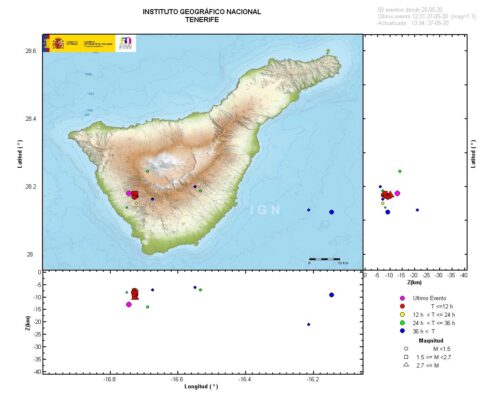
In the early hours of 27 May 2020, a series of earthquakes occurred below the area approximately 8 km north of Adeje and 6 km southeast of Guía de Isora on Tenerife. There were 142 detected earthquakes, with 42 of these located. The series began at 01:46 and the located earthquakes had magnitudes between -0.1 and 2.9 mbLg and depths between 7 and 10 km. Negative magnitudes occur when an earthquake is so small that it is below what was originally set as magnitude zero when the earthquake magnitude scale was created. Since then, our technology has dramatically improved, and thus, we can now detect smaller earthquakes with better technology. The largest magnitude, 2.9 event, at 03:51 was weakly felt in the town of Adeje with an intensity of II (EMS98).
This activity is part of the seismic activity that has been recorded in recent years, with almost constant activity characterized so far by low-magnitude events related to the magmatic activity below the island. The Adeje seismic station is a broadband sensor located in a borehole at 30 m depth and, therefore, has a very low noise level, allowing IGN to monitor the activity with precision.
🇪🇸 🇮🇨
En la madrugada del 27 de mayo de 2020, se produjo una serie de terremotos bajo la zona situada aproximadamente a 8 km al norte de Adeje y a 6 km al sureste de Guía de Isora, en Tenerife. Se detectaron 142 terremotos, de los cuales 42 fueron localizados. La serie comenzó a la 01:46 y los terremotos localizados tuvieron magnitudes entre -0,1 y 2,9 mbLg y profundidades entre 7 y 10 km. Las magnitudes negativas se producen cuando un terremoto es tan pequeño que está por debajo de lo que originalmente se estableció como magnitud cero cuando se creó la escala de magnitud de los terremotos. Desde entonces, nuestra tecnología ha mejorado drásticamente y, por lo tanto, ahora podemos detectar terremotos más pequeños con mejor tecnología. El evento de magnitud 2,9 más grande, a las 03:51, se sintió débilmente en la ciudad de Adeje con una intensidad de II (EMS98).
Esta actividad forma parte de la actividad sísmica que se ha registrado en los últimos años, con una actividad casi constante caracterizada hasta ahora por eventos de baja magnitud relacionados con la actividad magmática bajo la isla. La estación sísmica de Adeje es un sensor de banda ancha situado en un pozo a 30 m de profundidad y, por lo tanto, tiene un nivel de ruido muy bajo, lo que permite al IGN monitorizar la actividad con precisión.